A HERE CITY site

Lenders Want More Collateral: How to Build a Year-End Farm Balance Sheet Your Banker Will Trust
22% of Minneapolis Fed-district ag lenders now require more collateral. Here's how to build a year-end farm balance sheet and check 3 key ratios. How-to.
Key takeaways
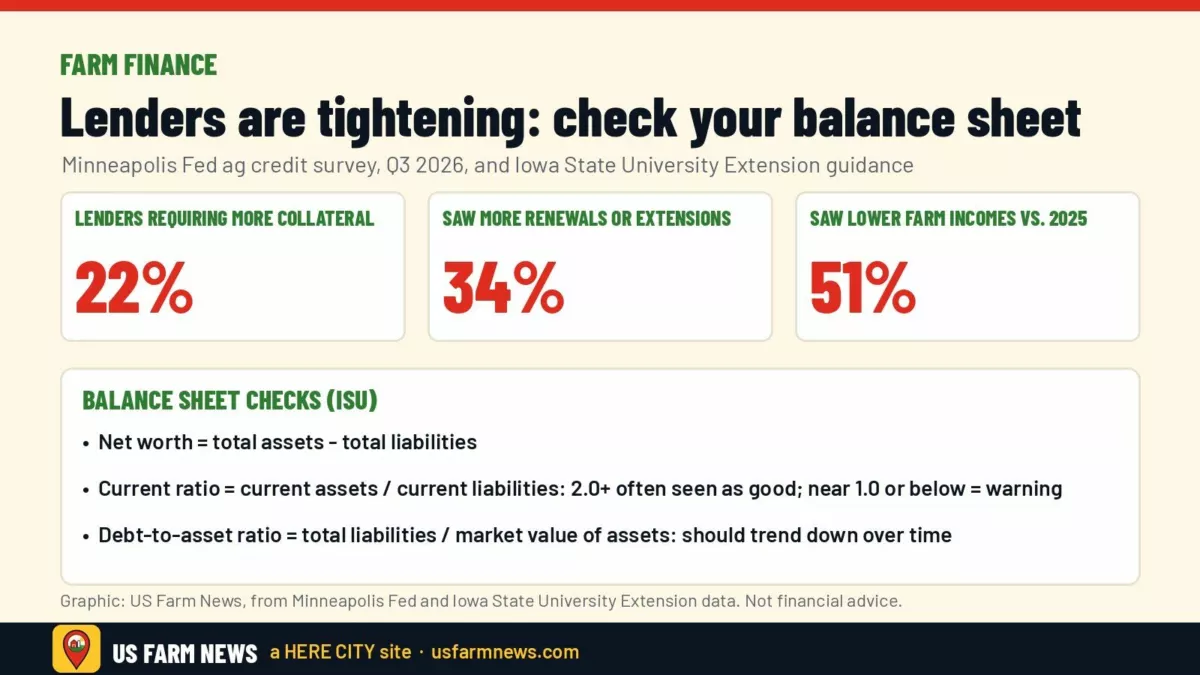
- In the Minneapolis Fed’s October survey, 22% of ag lenders said they now require more collateral, and 34% saw more loan renewals or extensions.
- A year-end balance sheet, dated Dec. 31 or Jan. 1, is the document lenders use to judge whether a farm can carry more debt.
- Iowa State University Extension says many lenders treat a current ratio of 2.0 or higher as solid, and one near 1.0 or lower as a cash-flow warning.
- The most useful test is the trend: compare this year’s net worth with last year’s, and ask your banker for the copy they keep on file.
Farm lenders in the Upper Midwest are getting more careful. In its third-quarter survey of agricultural bankers, released in mid-November, the Federal Reserve Bank of Minneapolis found that farm loan demand rose, repayment slowed and more lenders asked for extra collateral. That makes the year-end balance sheet, the simplest financial statement a farm has, more important than usual going into 2027 operating-loan talks.
Here is what lenders are seeing, and a step-by-step guide to building a balance sheet that holds up, based on Iowa State University Extension’s Ag Decision Maker guidance.
What the bankers said
About half of the lenders surveyed, 51%, said farm incomes in July through September were below a year earlier, the Minneapolis Fed said. That is still negative but marks a second straight quarter of improvement. Other findings from the survey of the Ninth District, which spans Minnesota, the Dakotas, Montana and the northwest corner of Wisconsin:
- 29% of lenders saw higher loan demand than a year earlier, nearly triple the share that saw lower demand.
- 34% reported more loan renewals or extensions; 5% reported fewer.
- More than a third said loan repayment had fallen from a year ago.
- 22% said they were requiring more collateral, continuing a trend from earlier surveys.
- Fixed and variable interest rates rose modestly on every major type of farm loan, from operating lines to real estate.
- Nonirrigated cropland values rose 2.5% from a year earlier, while ranch and pasture values jumped 13%.
The outlook was slightly brighter: 39% of lenders expect fourth-quarter incomes to beat a year earlier, versus 32% who expect a decline. “I don’t want to oversell it or be overly optimistic,” Joe Mahon, the Minneapolis Fed regional outreach director who wrote the report, told MPR News. He told Brownfield that farmers remain unsure about the longer-term outlook, and that rising interest rates add to that unease.
The same pressures show up in other Fed districts; see our report on the Kansas City Fed’s latest survey.
Why the balance sheet, not just break-evens
Grant Wiese of the farm financial advisory firm Farm640 told Brownfield that many young farmers focus on break-even costs. “I would encourage you to focus on your balance sheet,” he said, and make sure to get a copy of the one your banker has. He suggests lining up each year’s balance sheet against the last one to see if the business is heading the right way, and said beginning farmers should not hesitate to add off-farm or side income, such as working for a seed company or co-op or doing custom spraying.
Iowa State’s Ag Decision Maker describes the balance sheet as a snapshot of what the business owns and owes on one date. Assets minus liabilities equals net worth, or owner’s equity.
How to build it, step by step
- Pick the date. Most farm families use Dec. 31 or Jan. 1 because it matches the accounting year, ISU says. Using the same date every year makes comparisons valid.
- List current assets at realistic values. These are items normally sold or used within a year: cash, grain and feed, market livestock, supplies and prepaid expenses. ISU recommends valuing grain at the current market or contracted price minus marketing costs. Grain under a USDA marketing loan should be counted at the higher of market price or loan rate, with the loan listed as a liability. Include crop insurance payments or government payments that are earned but not yet received.
- Count what’s already in next year’s crop. Fall-applied fertilizer and other costs for a growing crop can be shown at the cost already incurred, according to ISU.
- Value fixed assets conservatively. Use your depreciation schedule as a machinery inventory. ISU suggests a conservative market value, and for land, a value that allows for selling costs such as a broker’s commission. Keep breeding-stock values steady from year to year so net worth does not swing on paper.
- List every liability by when it is due. Current liabilities include operating notes, credit lines, unpaid bills, and the principal due in the next 12 months on longer-term loans. Do not forget interest that has accrued since the last payment. ISU explains how to estimate it from the balance, rate and time elapsed.
- Keep personal items separate. Household assets and debts can be listed at the bottom, but business analysis should focus on the farm.
Three numbers to check
- Current ratio (current assets divided by current liabilities): ISU says many lenders view 2.0 or higher as good short-term strength and a ratio near 1.0 or below as a sign of possible cash-flow trouble. Livestock operations with steady sales can usually run lower than crop farms that sell once a year.
- Working capital (current assets minus current liabilities): some lenders prefer this dollar figure because it shows the cushion available for operating costs and family living.
- Debt-to-asset ratio (total liabilities divided by market value of total assets): ISU says a successful farm should see this fall over time, except in years when it borrows to buy land or other major assets.
ISU also flags two warning signs: a loan whose matching asset has already been sold or used up, and a long-lived asset such as a machine financed on a short-term note.
Before you meet your lender
- Compare this year’s net worth with last year’s. ISU notes a drop can come from low income, high family spending or big swings in asset prices, so look at which items changed.
- Pair the balance sheet with a cash-flow budget for 2027; ISU says that gives a better read on repayment ability.
- Bring records of anything that strengthens the picture, such as unpriced grain in storage or crop insurance due.
- If you are weighing machinery or land purchases, see our guide to current FSA loan rates.
This article is general information, not legal, tax or financial advice. Talk with your lender, accountant or a farm financial adviser about your own operation.
Frequently asked questions
What date should a farm balance sheet use?
Most farm families use Dec. 31 or Jan. 1 to match their accounting year, according to Iowa State University Extension. You can prepare one at any date, but using the same date each year makes comparisons meaningful.
What is a good current ratio for a farm?
ISU says lenders often see 2.0 or better as healthy short-term liquidity, while a ratio around 1.0 or below can signal cash-flow trouble. Dairy and other farms with regular sales can often operate with lower ratios.
Are lenders tightening farm credit?
In the Minneapolis Fed’s October survey, 22% of lenders said they were requiring more collateral and more than a third said repayment had slowed, though no banks reported turning down a loan because they were short of funds.
Get the Daily Ag Business Briefing
Markets, policy and farm business in one free email each weekday.