A HERE CITY site

Corn Harvest Hits 88% but Iowa Is 11 Points Behind Normal; Rain Lifts Winter Wheat to 53% Good to Excellent
USDA says corn is 88% harvested vs. a 92% average, with Iowa at 84%. Sorghum trails at 79%, and winter wheat improves to 53% good to excellent.
Key takeaways
- U.S. corn harvest reached 88% by Nov. 15, still 4 points behind the five-year average of 92%, USDA said Monday.
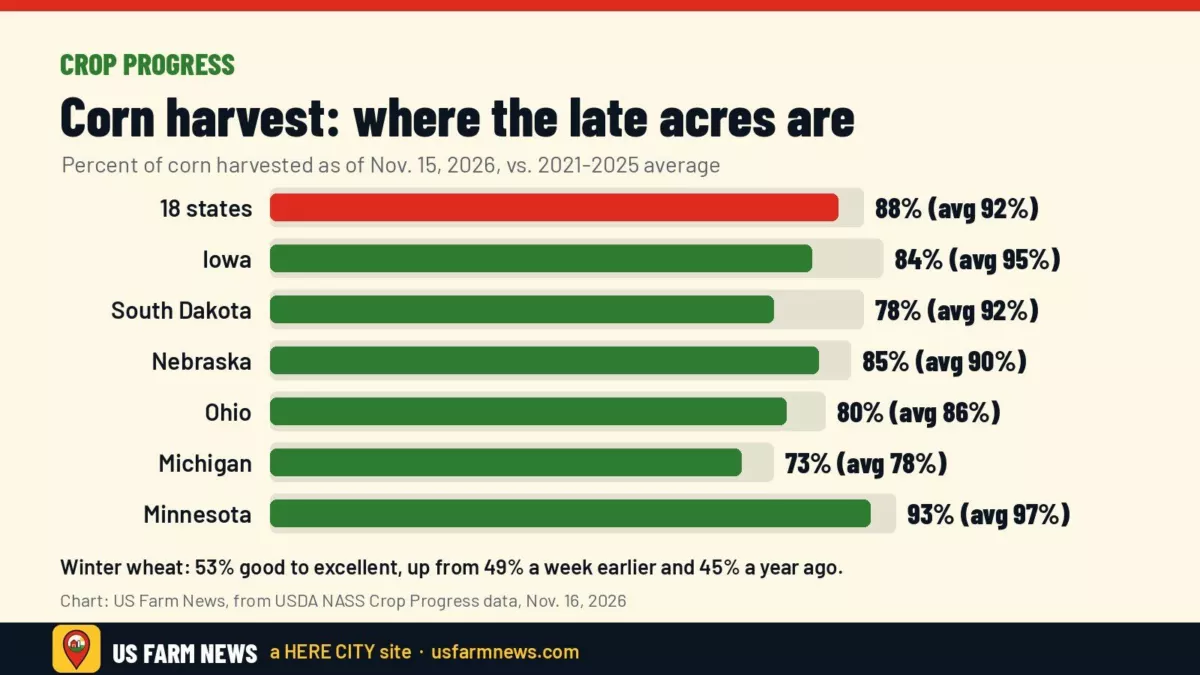
- Iowa is the biggest laggard: 84% of its corn is out, against a normal 95%. South Dakota, Ohio and Nebraska also trail.
- Sorghum harvest sits at 79% versus a 90% average, with Kansas only at 69%.
- Plains rain lifted winter wheat to 53% good to excellent, up from 49% a week earlier and 45% a year ago.
A drier week finally let combines roll across much of the Corn Belt, but the 2026 corn harvest is ending the season behind schedule, and a handful of states have a lot of acres left to cover. USDA’s National Agricultural Statistics Service said in its Nov. 16 Crop Progress report that 88% of the corn in the 18 major states had been harvested as of Sunday, Nov. 15. That compares with 81% a week earlier, 90% at this point in 2025 and a 2021-2025 average of 92%.
Soybeans are nearly done at 96%, a point ahead of normal. The bigger stories this week are the late corn and sorghum fields, and a winter wheat crop that rain has pulled into its best shape of the fall just before dormancy.
Why it matters for your bottom line
Every week a field stays standing adds cost and risk. Late corn means more drying expense, a tighter window for fall tillage and fertilizer, and more exposure to snow, lodging and stalk problems. It also matters for crop insurance: claims and harvest-related notices have their own deadlines, which we covered in our late-harvest crop insurance checklist.
For wheat growers, better crop ratings are good agronomic news but a headwind for price. Brownfield said Monday that the wheat market is oversold, yet export demand is slow and improved Plains conditions are adding to the pressure. December Chicago wheat fell 6¼ cents to $5.87 on Monday, while December corn gained 3¼ cents to $4.48¾, according to Brownfield’s closing table.
Corn: where the late acres are
Iowa made the biggest jump of the week, from 72% to 84% harvested, after NASS rated 5.9 days suitable for fieldwork in the state, up from just 1.7 days the week before. Even so, Iowa trails its five-year pace by 11 points. Other states behind normal, according to the NASS table:
- South Dakota: 78% harvested vs. a 92% average
- Nebraska: 85% vs. 90%
- Ohio: 80% vs. 86%
- Michigan: 73% vs. 78%
- Minnesota: 93% vs. 97%
- Kansas: 92% vs. 96%
A few states are at or ahead of schedule. Illinois is at its normal 96%, Indiana is at 93% against a 90% average, and Wisconsin is at 84% against 82%.
Some farmers who have finished are already changing plans for next year. North Iowa farmer Josh Hitzhusen told Brownfield he will do less fall tillage and move more of his soybean ground to no-till, which he expects to help margins by cutting fuel use.
Sorghum and late soybeans in Kansas
Sorghum harvest reached 79% nationally, compared with 90% on average. Kansas, the largest sorghum state, was at 69% against an 87% average, Nebraska at 68% against 85%, and South Dakota at 73% against 91%. USDA already cut the 2026 sorghum crop sharply in November, as we reported in our look at the smaller sorghum crop and Kansas yields.
Kansas soybeans were 87% harvested against a 92% average. Southeast Kansas farmer Ben Bellar told Brownfield his area went 48 to 49 days without rain during a stretch of 100-degree heat, which hurt first-crop beans. Later moisture let some plants green back up, which slowed harvest, and he said he may not finish until early to mid-December.
Winter wheat: rain improves ratings
NASS rated 53% of the winter wheat crop good to excellent, with 10% excellent and 43% good. A week earlier the figure was 49%, and a year ago it was 45%. Planting reached 92% (average 94%) and emergence 82% (average 81%).
State ratings vary widely. In the NASS table, Kansas wheat was 57% good to excellent, Nebraska 66%, Texas 49% and Oklahoma only 35%. Ohio’s crop was rated 72% good to excellent, Brownfield reported.
In southwest Nebraska, Roric Paulman told Brownfield that after roughly three years of little or no dryland corn harvest, he went back to winter wheat, a crop he had not planted in 10 years. “I don’t know how many more times a person can afford to take 0s on federal crop insurance,” he said, adding that timely rain has the new wheat looking good.
Other crops
- Cotton: 77% harvested, ahead of the 71% average.
- Peanuts: 87% harvested, about even with the 88% average.
- Sugarbeets: 96% harvested in the four major states, but Michigan is at 75% against a normal 95%.
- Sunflowers: 83% harvested, a point ahead of normal.
What to watch
- Next Monday, Nov. 23: the next Crop Progress report at 4 p.m. ET. Brownfield said the weekly national reports run through the end of the month.
- Thursday, Nov. 19: the U.S. Drought Monitor, important for Plains wheat heading into dormancy.
- Dec. 10: USDA’s next WASDE and Crop Production reports.
Get the Daily Ag Business Briefing
Markets, policy and farm business in one free email each weekday.