A HERE CITY site

Smart Sprayers Are Cutting Herbicide Use 30% to 65% on Some Farms: How See & Spray, Greeneye and Retrofits Compare on Cost
Growers report herbicide savings up to $35 an acre with AI camera sprayers. Compare a $5-per-acre fee vs. a $255,000 retrofit, and run your own break-even.
Key takeaways
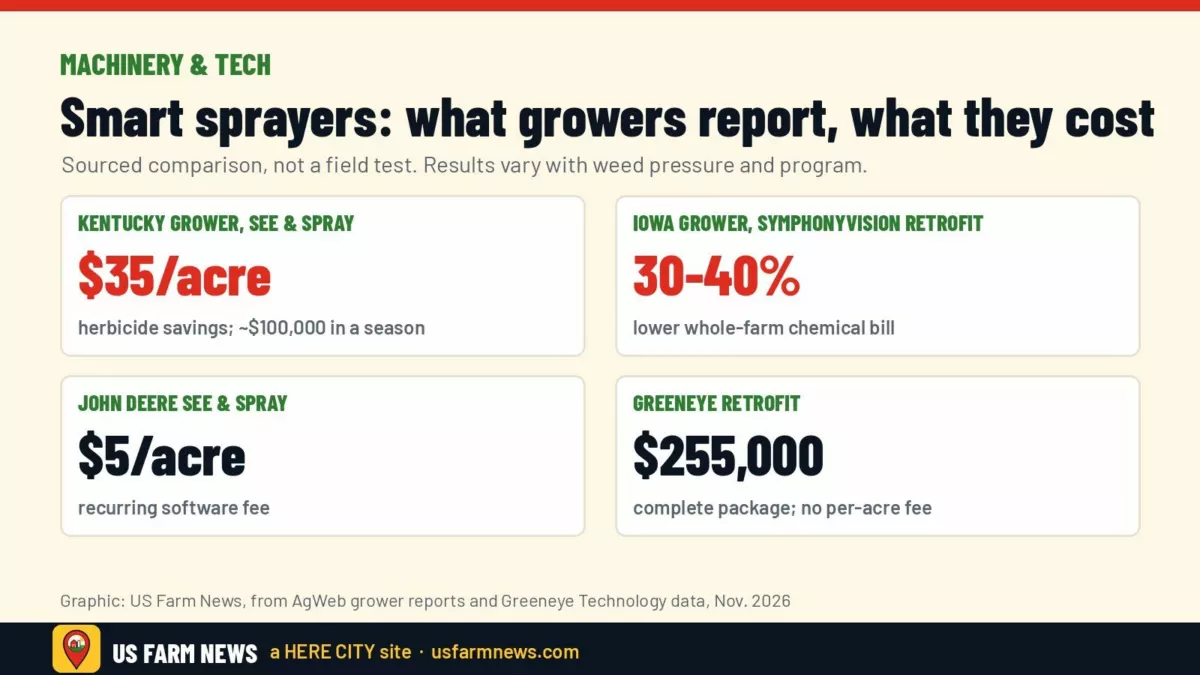
- Camera-guided “smart” sprayers are cutting herbicide use sharply on some farms: one Kentucky grower reported savings of $35 an acre and about $100,000 in a season, AgWeb reported.
- The pricing models differ: John Deere’s See & Spray carries a $5-per-acre software fee, while Greeneye sells a $255,000 retrofit with no per-acre charge.
- Dual-tank systems that broadcast residuals and spot-spray in one pass made the technology practical in corn and soybeans, but they add new tank-mixing and logistics work.
- Run the numbers on your own herbicide bill, acres and sprayer this winter, before making 2027 equipment decisions.
Sprayers that use cameras and artificial intelligence to spot weeds and fire only the nozzles that need to are moving from demo plots to mainstream row-crop farms. Two Midwest growers profiled by AgWeb on Nov. 12 say the savings on herbicide are big enough to change their budgets. The cost of getting there, though, depends on which system you choose and how the maker charges for it.
This is a sourced comparison based on grower reports and company information, not a US Farm News field test. Savings depend heavily on weed pressure, crop and herbicide program.
What growers are reporting
Michael Gallagher, who farms 2,500 acres of corn and soybeans with his father near Holly Springs, Iowa, put Precision Planting’s SymphonyVision Spot on his 2019 Hagie sprayer two years ago. He told AgWeb the farm’s yearly chemical bill has fallen 30% to 40% since then.
In Kentucky, Jonathan Royster runs a John Deere See & Spray Ultimate rig across 9,000 acres of corn and soybeans. Using it for burndown and post-emergence passes saved him $35 an acre on herbicide, about $100,000 in a season, AgWeb reported. His chemical use fell 34% in burndown, 51% in over-the-top corn applications and 65% in over-the-top soybean applications.
Gallagher also uses the low cost of targeted passes for a late clean-up trip. On that pass he said he might spray only 2% to 3% of a field, which keeps escaped weeds from setting seed and protects herbicides from resistance.
How the main systems compare
Based on what the companies and dealers have published or told AgWeb:
- John Deere See & Spray (factory option on Deere 400 and 600 Series sprayers): the farmer buys the hardware through a dealer and pays a recurring $5-per-acre fee for the targeted-spraying feature, according to AgWeb. AgWeb said See & Spray machines have now run over more than 10 million acres. For model year 2027, Deere’s See & Spray product manager Zach Becker told AgriNews the system adds higher-resolution cameras, new processors and front-mounted cameras, and extends targeted application beyond corn and soybeans to small grains, canola, sugar beets and edible beans.
- Greeneye Technology (retrofit): the complete package, which includes the company’s own aluminum boom plus the cameras, install, training and a warranty, is priced at $255,000 through January 2027, with no per-acre software fee, AgWeb said. On its website, Greeneye says most growers cut non-residual herbicide use 80% to 90%, that results vary, and that it works with most self-propelled models from John Deere, Hagie and Case IH. It currently offers 120-foot booms.
- Precision Planting SymphonyVision and PTx (retrofit): sold as a brand-agnostic retrofit, the route Gallagher took to avoid buying a new sprayer.
- New Holland IntelliSense: New Holland’s Jacob Maurer told AgWeb machines with the system have cut herbicide use 25% to 80%.
Greeneye also warns that camera and nozzle hardware can add 800 to 1,000 pounds to a boom, which it says can stress booms that were not built for the load. That is worth raising with whoever installs any retrofit.
Run your own break-even
A simple way to compare a per-acre fee with an upfront purchase is to start from your own herbicide spending:
- Find your post-emergence and burndown cost per acre. Residual herbicides still go on broadcast, so they do not count toward savings.
- Apply a cautious savings rate. Use the low end of published ranges unless you have local results. Royster’s 34% to 65% cuts came on one farm with its own weed pressure.
- Subtract the fee. Royster said the $5 fee “eats into your chemical savings,” though he still saw a substantial saving per acre. A John Deere dealer, Hutson, wrote in Michigan Farm News this summer that See & Spray averaged $12.63 an acre in savings after license fees in 2025, and said fallow-ground passes carry no fee. Ask your dealer exactly which acres are billed.
- For a purchase, divide price by net savings. At $35 an acre in savings, a $255,000 retrofit would need roughly 7,300 acres of treated passes to pay for itself, before interest and repairs. Greeneye says customers on 2,000 to 3,000 acres typically recover the cost in 18 months; treat that as the company’s claim, not a guarantee.
Our earlier year-end tax planning guide covers how equipment purchases are depreciated, which can change the after-tax math.
The workflow changes
Early spot-spray systems struggled in corn and soybeans because soil-applied residuals have to cover bare ground. Dual-line rigs solved that by broadcasting the residual and spot-spraying the contact product in one pass, PTx’s Bryce Baker told AgWeb. Royster said the trade-off is that two tanks empty at different rates and need more frequent filling, so he added an automated, iPad-controlled batching system to his tender.
Mixing also gets harder. Gallagher said that a load meant for 80 acres can stretch to 220 acres with spot spraying, so it takes time to learn how little product to mix for a given job.
The camera data can pay off later, too. Gallagher used weed-pressure maps from last season to build a variable-rate residual plan, putting heavier rates where weeds had escaped. Deere’s Becker told AgriNews its newer software can produce weed-pressure, crop-canopy and stand-count maps whether the sprayer is spot spraying or broadcasting.
Questions to ask before you buy
- Which crops, products and growth stages is the system approved for on your farm?
- How is the fee calculated, and is it charged on fallow or broadcast acres?
- Will your boom carry the added weight, and who services cameras and nozzles in season?
- Who owns the weed maps, and can you export them to your agronomist or other software?
For other ways AI is changing field work, see our report on laser weeding robots and their cost.
Get the Daily Ag Business Briefing
Markets, policy and farm business in one free email each weekday.