A HERE CITY site

In Yuma, AI Thinners Do a 40-Person Crew’s Work, but the Farm Network Isn’t Ready Yet
Yuma growers use AI thinners and drones on winter greens, but 23 of 34 farm broadband towers await hookups. Practical lessons before you buy connected tech.
Key takeaways
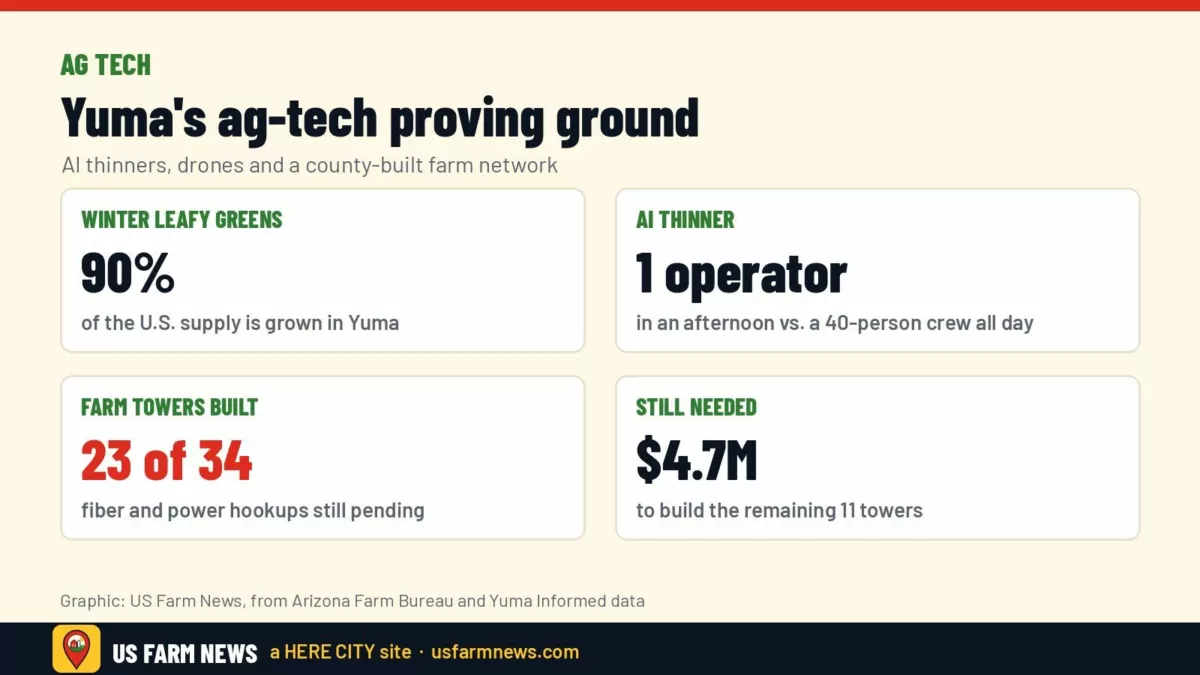
- In Yuma, Arizona, which grows 90% of U.S. winter leafy greens, AI camera thinners let one tractor operator do in an afternoon what a 40-person hand crew did in a day, the Arizona Farm Bureau reported.
- Some of the machinery costs more than half a million dollars, so growers adopt only tools that solve a clear problem.
- Yuma County has 23 of 34 planned farm broadband towers substantially built, but no service date yet, and about $4.7 million more is needed for the rest.
- The Desert Difference ag tech conference runs Dec. 9-10 in Yuma; free early registration ends Nov. 20.
Winter lettuce season is getting underway in Yuma, Arizona, and the fields there have become one of the country’s busiest test plots for farm artificial intelligence. A report published this week by the Arizona Farm Bureau describes AI-guided thinners, pest-scouting drones and bird-scaring drones working across a valley that supplies 90% of the nation’s winter leafy greens. It also shows the catch that growers everywhere run into: the technology only pays if it solves a real problem and if the farm can get the data off the field.
Camera thinners replace big hand crews
Lettuce growers plant far more seed than they need and then thin the stand so the remaining heads have room. That job used to take large hand crews. With labor hard to find, Yuma growers now use machines that combine AI-equipped cameras, nozzles and lasers to pick which plants stay, the Farm Bureau reported. One version described in the story rolls behind a tractor, feeding the lettuce it keeps and spraying diluted acid on the plants it removes.
The labor math is the selling point. According to the Farm Bureau, one person on a tractor can now finish in an afternoon what a 40-person crew needed a full day to do. The report said that comes at lower cost and with less risk of contaminating a crop that is mostly eaten raw.
Matt McGuire, chief agricultural officer at JV Farms, which farms more than 15,000 acres in the Yuma valley, told the Farm Bureau that precision agriculture isn’t really about GPS or straight rows; it’s about getting a result and being able to repeat it. He also said technology won’t fully replace the need for hand labor.
Drones for scouting and for birds
At the Yuma Agricultural Center, Corteva Agriscience and University of Arizona scientists are trialing new pest-control approaches, and drones are doing the scouting. A single drone can cover an acre in a few minutes, a job that used to take several researchers hours, according to the Farm Bureau. Corteva field scientist Erik Roldán said the imagery is detailed enough to spot individual insects feeding.
Drones are also common in Yuma for spraying pesticides without sending crews into fields. A growing number of growers fly them to keep birds, and their droppings, off leafy greens, sometimes broadcasting the call of a hawk.
The connectivity problem
All of those machines produce data, and moving it needs a signal. The Farm Bureau reported that major broadband providers weren’t interested in serving Yuma’s fields, so the county found money to build its own mix of fiber and wireless towers aimed mainly at growers, planned to reach 150,000 acres when finished.
That network isn’t ready yet. Yuma Informed, a local news site, reported in October that 23 of the 34 planned towers, each about 50 feet tall, were substantially complete as of Sept. 11. Fiber and electrical hookups were still unfinished, and the county hadn’t announced when growers could sign up, what service would cost or what speeds it would guarantee. County officials estimated another $4.7 million is needed to build the 11 towers not covered by current funding. The tower project has a separate $6 million state grant using federal pandemic-relief (ARPA) money, according to the report.
Planned uses include soil-moisture monitoring, remote irrigation control, machinery tracking and sensor data. Researchers and growers are already trying some of those uses on a connected test network at the University of Arizona’s Yuma Agricultural Center, Yuma Informed said.
Getting different brands of equipment to connect and share usable data is “a whole other beast,” Connor Osgood of the Yuma Center of Excellence for Desert Agriculture (YCEDA) told the Farm Bureau. He said the goal is less about cutting labor and more about removing tedious tasks such as checking irrigation pumps and lines.
Practical takeaways for any farm
- Start with the problem, not the gadget. Yuma’s thinners spread because a specific job, thinning, ran short of workers. Put a dollar figure on the task you want to automate before you price a machine.
- Do the crew math honestly. Compare hours, wages and timing risk against purchase or custom-hire cost. Some of the machinery tops half a million dollars, as YCEDA’s Tanya Hodges pointed out, so the payback has to be clear.
- Check connectivity first. Sensors, remote irrigation and telematics need coverage where the work happens. Ask your provider, co-op or county about field-level service before buying connected equipment.
- Ask about data sharing. Before you add a new brand, find out whether its data will flow into the software you already use.
- Keep people in the plan. Even Yuma’s biggest adopters say hand labor isn’t going away; technology shifts what workers do.
The Desert Difference conference, sponsored by YCEDA and the University of Arizona Yuma Agricultural Center, runs Dec. 9-10 in Yuma, where startups will demonstrate different technologies running together on a wirelessly linked farm. Free early registration is open until Nov. 20 at desertagsolutions.org, according to the Farm Bureau.
For more on camera-guided weed control, see our look at smart sprayer costs and break-even math and our report on laser weeding robots for vegetables.
Get the Daily Ag Business Briefing
Markets, policy and farm business in one free email each weekday.