A HERE CITY site

Lease or Buy That Tractor? 5 Things to Check as High Rates Push Farmers Toward Equipment Leases
High rates and costly machines are pushing more farmers to lease, AEM says. Here's how operating and capital leases differ on taxes, use caps and trade-ins.
Key takeaways
- Cheap grain, costly inputs and stubbornly high borrowing costs are steering more equipment buyers toward leases, the Association of Equipment Manufacturers’ Curt Blades told Brownfield.
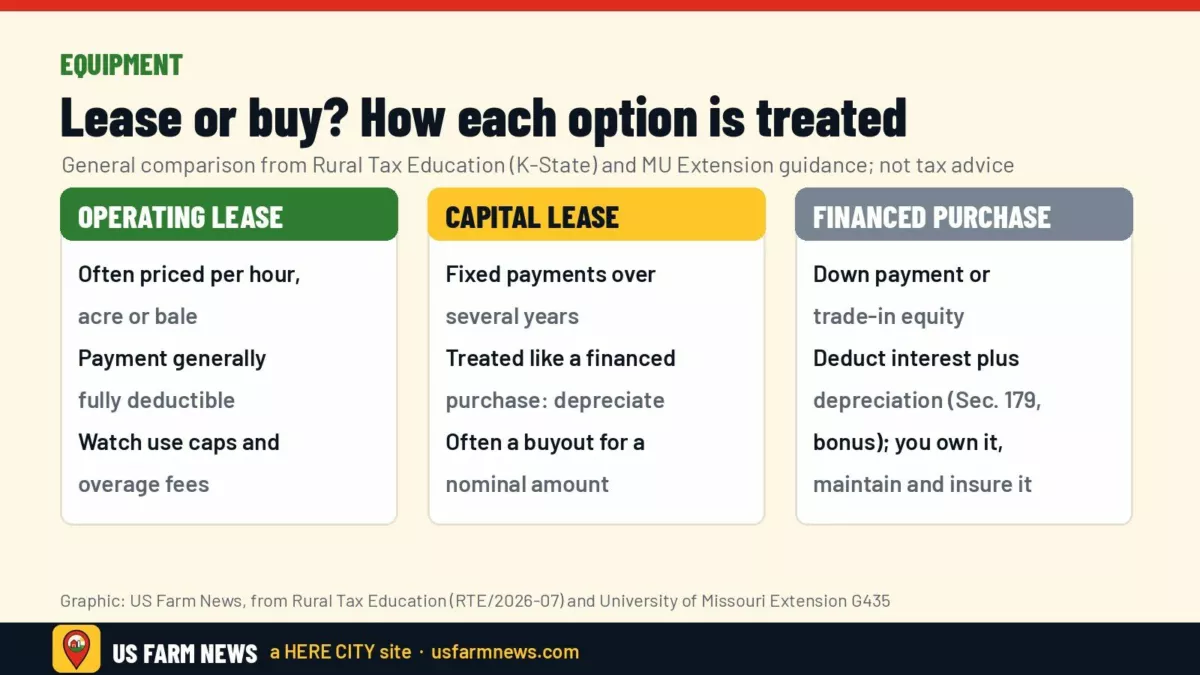
- Payments on an operating lease can usually be written off in full; a lease the IRS treats as a capital lease is handled like a financed purchase, with depreciation and interest.
- Watch for annual hour caps and overage fees, and for a depreciation recapture tax bill when a trade-in is used as a lease down payment.
- Rates may not fall soon: a Federal Reserve governor this week leaned toward a half-point hike in December, Pro Farmer reported.
If you’re pricing a new tractor, sprayer or combine this winter, there’s a good chance the dealer will put a lease quote next to the loan quote. Curt Blades of the Association of Equipment Manufacturers (AEM) told Brownfield on Nov. 18 that buyers are getting more creative with financing, with weak crop prices, expensive inputs and today’s interest rates all working against them.
Blades said he has even heard dealers use the term “capital lease” for what amounts to a lease with a bigger down payment. With rates where they are, he said, a lease “might just be the right situation for a farm.” He added that machines keep getting more expensive and that many farmers don’t want to tie up capital in an asset that loses value.
A lease can be a smart tool. It can also cost more than it looks. Here’s what extension economists say to check before you sign. This is a sourced buyer’s guide, not a hands-on review of any lender’s product.
1. Know which kind of lease you’re signing
A Rural Tax Education fact sheet dated April 2026 by Mark Dikeman, executive director of the Kansas Farm Management Association at Kansas State University, lays out four ways to acquire a machine: pay cash, finance a purchase, sign an operating lease, or sign a capital lease (also called a conditional sales contract).
- Operating lease: Usually shorter, often priced per unit of use such as engine or separator hours, acres or bales. Because it’s tied to use, the total cost may not be known in advance.
- Capital lease: Usually several years with a fixed payment no matter how much you use the machine, and often an option to buy it at the end for a token amount.
The label in the dealer’s paperwork doesn’t settle it. Drawing on IRS Publication 225, the Farmer’s Tax Guide, the fact sheet lists signs that a “lease” is really a purchase for tax purposes: part of each payment builds equity, you get title after a set number of payments, payments run well above fair rental value, part of the payment is identified as interest, or you can buy the machine for a nominal price at the end. No single factor decides it, and the parties’ intent matters.
2. Understand the tax treatment
With a true operating lease, you can generally deduct the whole payment as a business expense, according to the fact sheet. With a loan, only the interest is deductible; the principal is recovered through depreciation. Current rules make that depreciation very flexible: with Section 179 expensing or bonus depreciation, the whole purchase price can be deducted in the year the machine goes into service.
If the IRS would treat your lease as a capital lease, you depreciate the machine and split each payment into principal and interest, just like a loan. Our 2026 year-end tax planning guide covers how Section 179 timing fits into a December purchase.
3. Watch the trade-in tax trap
Dikeman flags a less obvious risk. If you hand the dealer a machine you own as equity or a down payment on a lease that is not a capital lease, the trade-in is treated as sold. That can trigger depreciation recapture, which shows up as taxable gain on your return. On a fully depreciated machine, that can be a sizable surprise. Ask your tax preparer to run the numbers before you sign.
4. Read the use limits and the fine print
University of Missouri Extension’s guide to machinery ownership costs notes that many leases cap annual use and charge steep overage fees, and may bar modifications that could hurt resale value. Most leases require you to carry insurance on the machine. Repairs and maintenance may or may not be your job depending on the contract, the Rural Tax Education sheet adds, so check who pays.
MU Extension also points out a practical wrinkle: since the payment is the same whether you use half or nearly all of your allowed hours, it pays to put the leased machine to work up to the limit.
5. Compare the lease with a loan, and with custom hire
- Convert the lease to an interest rate. For a lease that works like a purchase, the fact sheet suggests starting from the machine’s price and backing out an effective interest rate from the payments, then comparing it with what lenders quote.
- Think about how long you’ll keep it. Buying outright may make sense if you’ll use the machine for more than a few years, and paying cash can give you more negotiating power, the fact sheet says. The downside is the cash it ties up.
- Price custom hire. For big or specialized machines needed only briefly, MU Extension says hiring a custom operator is often cheaper than owning or leasing, though you give up control over timing.
- Get advice from someone without a stake. The fact sheet recommends a trusted adviser with no financial interest in the deal.
Why the timing matters now
MU Extension notes that leasing tends to gain popularity when the farm economy can’t support big equipment upgrades, because the payment is a known annual cost. Interest rates are the other driver. Fed Governor Chris Waller this week signaled a preference for a half-point rate increase in December, Pro Farmer reported, which helped push the dollar to its highest level since early April 2025. For more on where new-equipment demand stands, see our report on AEM’s October tractor and combine sales and our look at used tractor and planter auction values.
Frequently asked questions
Is a farm equipment lease payment tax deductible?
Generally yes for a true operating lease, where the full payment is a deductible business expense. If the IRS would treat the lease as a capital lease or conditional sales contract, you instead depreciate the machine and deduct only the interest portion of payments.
What is a capital lease?
Extension materials describe it as a longer, fixed-payment lease that often lets you buy the machine at the end for a nominal amount. For tax purposes it is treated much like a financed purchase.
Can trading in equipment on a lease create a tax bill?
Yes. If owned equipment is used as equity or a down payment on a lease that isn’t a capital lease, it’s treated as sold, which can trigger depreciation recapture taxed as gain.
This article is general information, not legal, tax, or financial advice. Talk with your tax preparer and lender about your situation.
Get the Daily Ag Business Briefing
Markets, policy and farm business in one free email each weekday.