A HERE CITY site

New Drain Tile Flooding a Neighbor’s Field? 3 Legal Rules and a Checklist to Avoid a Lawsuit
Tile that sends water onto a neighbor's land can bring a lawsuit. How the three surface water rules work, USDA's AD-1026 form and steps to take before tiling.
Key takeaways
- New drain tile that pushes water onto a neighbor’s field can lead to a lawsuit, a Farm Progress legal column warns.
- States follow one of three legal doctrines on surface water (common enemy, natural flow or reasonable use), and most of them can make the upstream farmer liable for damage.
- Farms in USDA programs must file form AD-1026; tile placed too close to a wetland can cost you program eligibility, even though NRCS doesn’t permit tile.
- Ohio State’s ag law program says the first step in a dispute is usually a neighbor-to-neighbor fix, then a county drainage petition, and a negligence claim only as a last resort.
As harvest winds down and farms line up drainage projects, a legal column published Nov. 20 by Farm Progress opens with a familiar call: a farmer whose field started flooding after a neighbor installed new drain tile that sent water onto his ground. Tile is among the best-paying investments a crop farm can make, but water crosses fence lines, and the law in your state decides who pays when it does damage.
Why it matters to your bottom line
Tile can dry fields faster, lengthen the season and protect yields from waterlogging, the column notes. The same project can also trigger permit problems, the loss of USDA program benefits if a wetland is affected, or a damage claim from the farm downstream. A few hours of planning before the plow goes in is cheaper than any of those.
The three legal rules on surface water
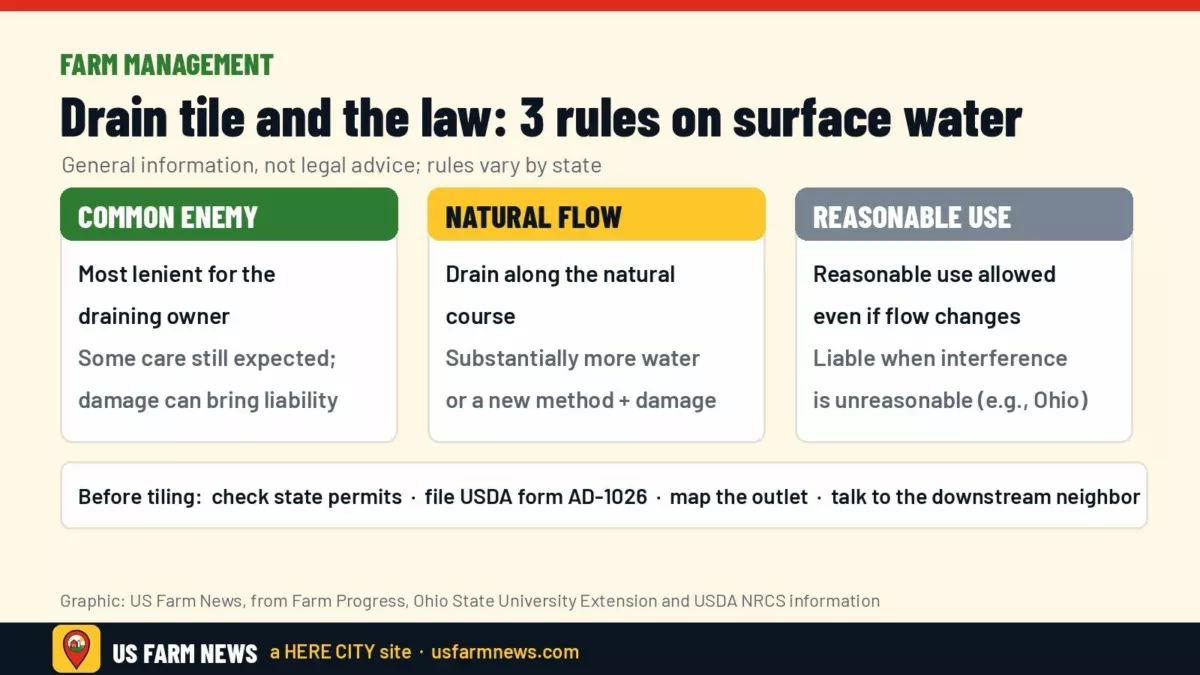
Courts have used three main doctrines for disputes over diverted surface water, according to Farm Progress:
- Common enemy. The most lenient for the draining landowner. Historically it treated surface water as something every owner could get rid of. Today, as the column describes it, even states using this rule may expect some degree of care when an upper landowner discharges water onto lower ground, and a farmer could still be liable for damage.
- Natural flow. A landowner may drain water along its natural course, but if the volume rises substantially or the drainage method changes substantially and the neighbor suffers actual damage, the neighbor can get relief.
- Reasonable use. Each owner can make reasonable use of the land, even if that changes how water flows, but is liable when the interference is unreasonable.
Ohio is a reasonable-use state. Ohio State University Extension’s Agricultural & Resource Law Program explains that the state once followed the common enemy approach, which let owners shed surface water no matter the harm, before the Ohio Supreme Court adopted reasonable use in a 1980 drainage case, McGlashan v. Spade Rockledge.
How courts decide what’s “reasonable”
Under reasonable use, a judge or jury decides each case on its facts. OSU’s bulletin lists four factors drawn from the Restatement of Torts:
- Utility: the purpose and economic and social value of the drainage.
- Gravity of the harm to the neighboring property.
- Practicality of avoiding the harm, such as a different outlet or design.
- Justice: how unfair it would be to make the neighbor absorb the losses.
A project with little value, poorly suited to the area, that does a lot of damage and could have been designed around the problem is the kind likely to be found unreasonable, OSU says.
Permits and USDA program eligibility
Permit rules vary by state. In Wisconsin, for example, the column says the Department of Natural Resources reviews tiling in or next to designated wetlands, while work outside wetland areas, repairs or replacements of working tile at the same grade, size and depth, and some installation methods such as vibratory plowing are generally exempt. The DNR’s own wetland map can be inaccurate, so the column suggests calling the agency.
The federal piece applies nearly everywhere. Farms in USDA programs, from FSA loans and crop insurance to EQIP, CSP and CRP, must complete form AD-1026, which certifies compliance with highly erodible land and wetland conservation rules, according to Farm Progress. Those wetland rules, often called Swampbuster, date to the 1985 farm bill, USDA’s Natural Resources Conservation Service says.
NRCS is clear about the limits of its role. Its Nebraska office says the agency doesn’t regulate or permit tile, doesn’t interpret state drainage law and doesn’t decide where outlets go, unless placement would convert a wetland and put program eligibility at risk. Only the landowner or a formally designated representative can get the certified wetland determination, NRCS says, and it points farmers with drainage disputes to state law or an attorney.
A pre-tiling checklist
- Learn your state’s rule. Find out which doctrine your state follows and whether your county has a drainage district or engineer that must sign off.
- Check permits. Contact your state natural resources agency if any part of the project is in or near a mapped wetland.
- File or update AD-1026 at your FSA office before you start, and ask whether a certified wetland determination exists for the field.
- Map the outlet. Have your installer show where the water goes and how much more of it will leave your land. Under the natural flow rule, a substantial increase in volume or a change in drainage method is what can open the door to liability.
- Talk to the downstream neighbor. A conversation, and possibly a written agreement on outlets or shared costs, can head off a dispute.
- Keep records of designs, permits and photos of field conditions before and after.
If you’re the one getting flooded
OSU’s bulletin lays out a sequence. The preferred fix is an agreement between the two landowners. Failing that, landowners can go through the county engineer or the local soil and water conservation district to petition for a drainage improvement project, paid for through assessments on the land that benefits. If a neighbor won’t act, the harmed owner can pursue a negligence claim, often starting with an attorney’s demand letter. In Ohio, claims of $6,000 or less can go to small claims court, the bulletin notes. Rules and dollar limits differ by state.
Planning drainage spending into next year’s budget? See our 2027 cash-flow planning guide and more practical help in our farm management section.
Frequently asked questions
Can I be sued if my new drain tile floods a neighbor’s field?
Yes. Under the natural flow and reasonable use rules, and in some cases even the common enemy rule, a farmer whose tile causes damage downstream can be liable, depending on state law and the facts.
Do I need a permit to install drain tile?
It depends on your state and whether the land is in or near a wetland. Wisconsin’s DNR, for example, reviews tiling in or next to designated wetlands. NRCS does not issue tile permits.
What is form AD-1026?
It’s the USDA certification that a farm complies with highly erodible land and wetland conservation rules. Farms in programs such as FSA loans, crop insurance, EQIP, CSP and CRP must file it.
This article is general information, not legal, tax, or financial advice. Drainage law varies by state; consult an attorney or your county drainage authority about your situation.
Get the Daily Ag Business Briefing
Markets, policy and farm business in one free email each weekday.