A HERE CITY site

Thailand Trade Deal Promises $2.6 Billion in U.S. Farm Purchases, but Pork Access Faces Pushback
Trump says Thailand will buy $2.6 billion more U.S. farm goods and open to pork and beef. The deal isn't signed, and Thai hog farmers want feed buys instead.
Key takeaways
- President Trump says Thailand will buy about $2.6 billion in additional U.S. farm products under a reciprocal trade agreement the two countries declared substantially concluded in Manila on Nov. 17.
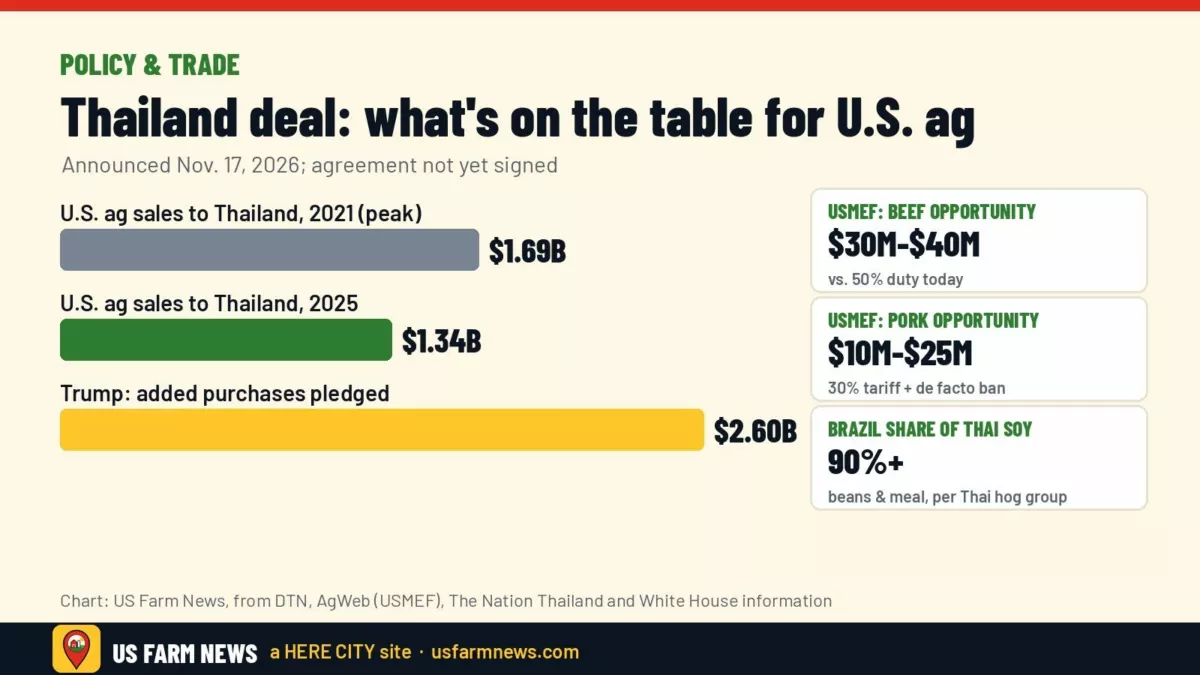
- Thailand bought $1.34 billion of U.S. agricultural products in 2025, DTN reported, so the pledge would roughly double the market if it’s delivered.
- The U.S. Meat Export Federation sees a quick $30 million to $40 million beef opportunity and $10 million to $25 million for pork, a market it says is effectively closed to U.S. product today.
- The deal isn’t signed. Thai pig farmers are lobbying against pork access and pitching more U.S. corn, soybeans and soybean meal instead.
The United States and Thailand say they’re close to a trade agreement that could double U.S. farm sales to the Southeast Asian country, but U.S. growers and ranchers shouldn’t count the money yet. The two governments signed only a joint statement this week, and Thailand’s hog industry is already pushing back on the part that matters most to U.S. pork.
What was announced
President Donald Trump and Thai Prime Minister Anutin Charnvirakul confirmed on Nov. 17 in Manila that their negotiators had reached “substantial conclusion” on an Agreement on Reciprocal Trade, according to a joint statement posted by the White House. Next, each government has to clear the text at home before anyone signs it or it enters into force, the statement said.
At the signing, Trump said Thailand would drop its tariffs on U.S. exports, remove nontariff barriers on goods including ethanol and poultry, and purchase roughly $2.6 billion more in American farm goods, according to DTN and AgWeb. “That makes our farmers very happy,” Trump said, as quoted by AgWeb.
No product list has been published. Earlier frameworks between the two countries covered corn, soybean meal, distillers grains and ethanol, AgWeb reported. Farm Progress, carrying a Bloomberg report, said Thai Foreign Minister Sihasak Phuangketkeow confirmed his country would move toward zero tariffs, open its market to U.S. pork and buy U.S. soybeans, some of which would go into products Thailand makes for export.
Why it matters: a steady market that could double
Thailand is a reliable but mid-sized customer. It bought $1.34 billion in U.S. farm products in 2025 and was running at about that pace this year, DTN reported, with purchases peaking at $1.69 billion in 2021. Most of what it buys falls into grain and feed, horticultural products, oilseeds and livestock products. Farms.com, citing USDA data, said soybeans, wheat, cotton and dairy ranked among the top 10 U.S. farm exports to Thailand in 2025.
A $2.6 billion figure, if it represents total annual farm purchases, would be close to double the 2025 level, which is how DTN framed Trump’s claim. Whether the number is new money on top of current sales or a total, and over what period, hasn’t been spelled out.
U.S. feed grain groups welcomed the news. Ryan LeGrand, who heads the U.S. Grains & Bioproducts Council, said the agreement’s commitment to annual imports would give U.S. farmers “a reliable boost in demand” once it is finalized, according to a statement reported by Farms.com.
Beef and pork: the biggest potential upside
For red meat, the opening would be from a very low base. Dan Halstrom, president and CEO of USMEF, told AgWeb that Thailand imposes a 50% duty on U.S. beef, which keeps American product uncompetitive in a market where Australia is the top imported-beef supplier with well over $200 million in sales. USMEF pegs the immediate U.S. beef opportunity at $30 million to $40 million.
Pork faces a 30% tariff, but the bigger obstacle is a set of restrictions Halstrom described as “a de facto type of ban on U.S. pork.” He estimated a $10 million to $25 million immediate opening for U.S. pork, and said the opportunity could be larger because Spain, one of the few European suppliers, has been delisted over African swine fever. Halstrom called pork’s inclusion “a pleasant surprise,” but stressed the gains depend on the agreement actually being signed and barriers coming down, AgWeb reported.
That’s welcome news for hog producers facing steep losses this fall. Our recent report on lean hogs at a contract low explains why new export outlets matter.
The pushback in Bangkok
Thailand’s pig farmers are fighting the pork piece. The Swine Raisers Association of Thailand said in a Nov. 19 statement that its members lost money for three straight years from 2023 through 2025 and could face a fourth losing year in 2026, The Nation Thailand reported. The group argued Thailand already produces enough pork for its own market and urged the government not to trade away pork access.
Instead, the association proposed that Thailand buy more U.S. feed ingredients: feed corn, which the country doesn’t grow enough of, plus soybeans and soybean meal, which it imports almost entirely. By the group’s count, Brazil ships more than 90% of the soybeans and meal Thailand imports, so some of that business could shift to U.S. suppliers. The group also asked the government to keep its restrictions on ractopamine, a feed additive allowed in U.S. pork production, according to The Nation and The Thaiger.
For U.S. soybean growers, that counterproposal may matter as much as the headline number. Shifting even part of Thailand’s Brazil-dominated meal and bean imports would help at a time when China’s buying remains uncertain, as covered in our report on the Trump-Xi soybean tariff talks.
What’s still unsettled
- Signature and ratification. Both countries must finish domestic legal steps first. Anutin said “there is still a little more to do,” according to the Bloomberg report carried by Farm Progress.
- Tariff terms. The joint statement didn’t list final tariff rates. Bloomberg reported that Thai officials see the U.S. keeping a 19% tariff on most Thai products, and the Thai government said a plan to make 99% of U.S. goods duty-free is still being negotiated, with some quotas to protect domestic producers, according to DTN.
- Product details. No official list of farm products, volumes or timing has been released.
What to watch
- Publication of the final agreement text and any USDA or USTR fact sheet listing farm products.
- Whether Thailand’s pork access survives domestic pressure, and how ractopamine rules are handled.
- USDA’s weekly export sales for any Thai purchases of soybeans, meal, corn or wheat.
Get the Daily Ag Business Briefing
Markets, policy and farm business in one free email each weekday.