A HERE CITY site

Port Strike Threat at Los Angeles-Long Beach: 250 Guards’ Contract Expires, Putting Farm Exports and Parts at Risk
A contract for 250 port guards expired Saturday at LA-Long Beach, where their terminals move over half the cargo. What a strike could mean for farm shippers.
Key takeaways
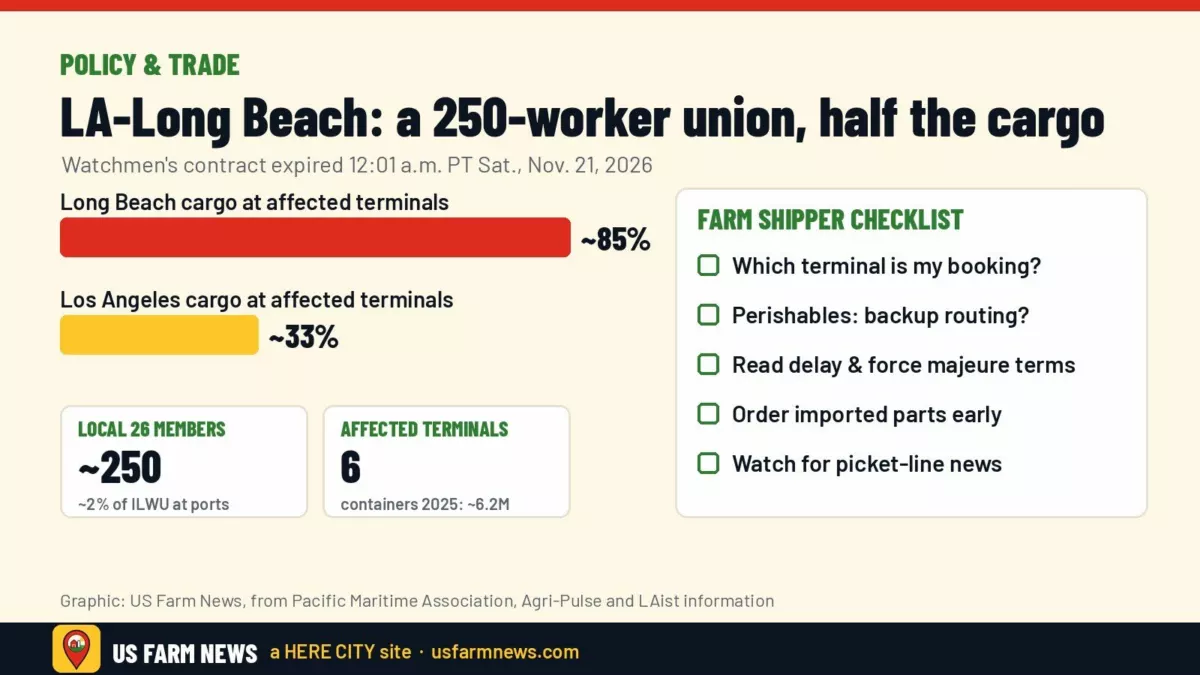
- The contract for about 250 security watchmen at the Los Angeles and Long Beach ports ran out at 12:01 a.m. PT Saturday, Nov. 21, and their union had already voted to authorize a strike.
- Those watchmen work at terminals handling roughly 85% of Long Beach cargo and 33% of Los Angeles cargo, and thousands of dockworkers are expected to honor any picket line, the employers’ group said.
- California Farm Bureau warned that perishable produce can’t wait at a terminal and that lost export markets are hard to win back.
- Exporters and anyone waiting on imported parts or inputs should check booking status with carriers and forwarders now.
A labor fight involving one of the smallest unions on the Southern California waterfront could slow farm exports through the busiest container port complex in the country. The contract between the Pacific Maritime Association (PMA), which represents terminal operators and shipping lines, and International Longshore and Warehouse Union Local 26 was set to expire at 12:01 a.m. Pacific time Saturday, after the two sides met Friday in a last attempt to reach a deal, according to the PMA and Agri-Pulse.
As of early Saturday, US Farm News had not seen confirmation of either a settlement or picket lines. Check with your carrier or freight forwarder for the latest before moving cargo.
Why it matters to your bottom line
Local 26 has only about 250 members, roughly 2% of the ILWU workforce at the two ports, but they guard six container terminals that move more than half of the complex’s freight, the PMA said. The employers expect thousands of dockworkers, clerks and foremen who have no stake in this dispute to refuse to cross a picket line. That would effectively stop cargo at those terminals.
For agriculture the risk runs both ways. Farms ship perishables and other exports through these terminals and also count on them to bring in machinery, parts and supplies, California Farm Bureau President Shannon Douglass told Agri-Pulse. Fresh fruits and vegetables can’t sit in a terminal, she said; a stoppage means spoiled loads, missed sailings and lost income.
“We know how difficult it is to win back markets once they are lost,” Douglass said in a statement to Agri-Pulse.
What’s at stake in the talks
- Bargaining history: the union’s previous contract expired in July 2025, and talks have dragged on for more than a year, with federal mediators now involved, LAist reported.
- Employer offer: the PMA says it offered a $3,200 one-time bonus per worker and a wage package that would raise average annual earnings to $198,000, up from more than $170,000, for full-time watchmen, along with employer-paid health care and higher pensions.
- Union position: Agri-Pulse, citing financial news site BigGo Finance, reported that the union doesn’t trust the PMA’s figures. Local 26 hadn’t responded to requests for comment from Agri-Pulse or LAist.
- Automation: Agri-Pulse noted that automation of cargo handling has been a central sticking point for port unions more broadly.
How big the ports are
Together, the two ports move more than 31% of the nation’s containerized goods, and both set cargo records in September, LAist reported. An analysis for the PMA by maritime economist John Martin found the six affected terminals handled about 6.2 million containers in 2025. Martin said the losses from a strike would grow faster each day it lasts, because ships couldn’t be unloaded and boxes already on the docks couldn’t leave. Diverted cargo would add congestion at Oakland and Pacific Northwest ports, according to Agri-Pulse.
Agriculture has been burned before
Agri-Pulse recalled that a drawn-out West Coast labor dispute in 2014-15 left Asia-bound citrus to rot, and a container shortage during the pandemic cut California farm exports 17% over five months in 2021. The last formal strike at the two ports, in 2012, involved about 800 clerical workers and shut 10 of the 15 terminals for eight days.
Shipping has been a recurring cost issue this fall, from a shrinking barge fleet on the inland rivers to the proposed Union Pacific-Norfolk Southern rail merger.
What to do now
- Call your forwarder or carrier. Ask which terminal your booking uses, whether it’s one of the six covered by the dispute, and what the backup plan is.
- Protect perishables first. If you have flexibility, ask about routing through other gateways, recognizing those ports could get crowded fast if cargo is diverted.
- Review your contracts. Check delay, demurrage and force majeure terms with buyers and carriers before a disruption, not after.
- Order critical parts early. If you’re waiting on imported machinery parts or inputs for winter repairs or spring, ask your dealer where they’re coming from.
What to watch
- Whether picket lines go up at any of the six terminals, or the sides agree to keep talking.
- Any involvement from federal officials, and statements from shipper and farm groups.
- How long any backlog takes to clear after work resumes.
More trade coverage is in our Policy & Trade section.
Get the Daily Ag Business Briefing
Markets, policy and farm business in one free email each weekday.