A HERE CITY site

October Feedlot Placements Fall 7% to 1.89 Million Head, Lowest on Record; Marketings Also Hit an October Low
USDA says October feedlot placements fell 7% to 1.891 million head, the lowest October since 1996, and far below trade guesses. What it means for prices.
Key takeaways
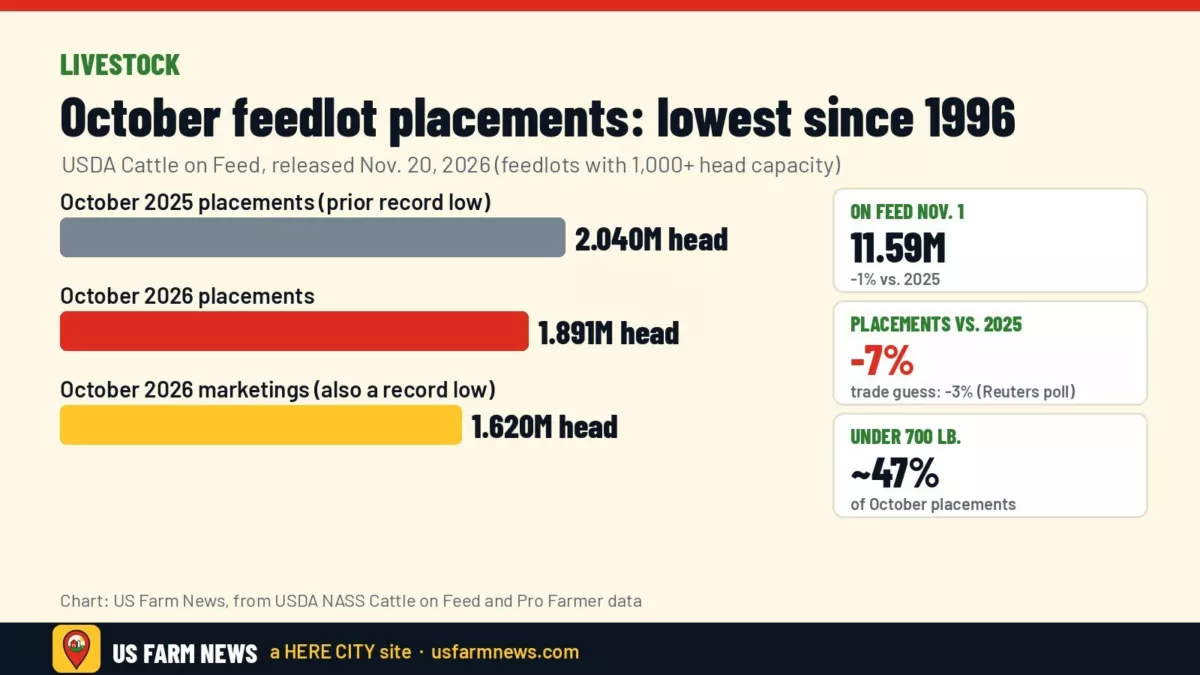
- Feedlots placed 1.891 million head in October, down 7% from a year ago and the smallest October total in USDA records going back to 1996.
- October marketings of 1.620 million head were also an October low, while the Nov. 1 on-feed count of 11.59 million ran about 1% under 2025.
- Analysts had expected placements to fall only about 3%, so the report points to even fewer fed cattle next spring and summer.
- Futures had already closed when the report came out Friday; Monday’s trade, in a holiday-shortened week, is the first chance for the market to react.
U.S. feedlots took in fewer cattle in October than in any October since USDA began keeping this series in 1996, the National Agricultural Statistics Service said Friday in its monthly Cattle on Feed report. Placements into lots with 1,000 or more head totaled 1.891 million, down from 2.040 million a year earlier, which itself had been the previous October low, according to Pro Farmer.
The cut was much deeper than the trade expected. A Reuters survey of analysts, cited by Pro Farmer, had placements at 97% of last year; USDA put them at about 92.7%.
Why it matters to your bottom line
Cattle placed in October are largely the fed cattle packers will be bidding on next spring and summer. Fewer placements now generally means a tighter supply of market-ready animals later, which supports fed and feeder prices for cow-calf operators and backgrounders with cattle to sell. For feeders and packers, it means more competition for every animal and continued pressure on slaughter capacity.
Brownfield said the numbers look bullish over both the short and long run, but cautioned that the Thanksgiving holiday could blunt the immediate response and that longer-term price direction will also depend on how well beef demand holds up.
The numbers
From USDA’s Nov. 20 report, for feedlots with at least 1,000 head of capacity:
- On feed Nov. 1: 11.590 million head, 1% below a year ago. Pro Farmer said that was 81,000 head under the average trade guess, and the second straight month the count has trailed year-earlier levels.
- October placements: 1.891 million head, 7% lower than October 2025 but 6% more than September’s 1.777 million. Net placements were 1.84 million.
- October marketings: 1.620 million head, down 5%. That beat the old October low of 1.630 million set in 2015, Pro Farmer noted, as packers kept slaughter rates trimmed.
- Other disappearance: 53,000 head, 2% below last year.
Light cattle made up nearly half the placements
USDA’s weight breakdown shows 490,000 head placed under 600 pounds and 400,000 at 600 to 699 pounds, so together cattle under 700 pounds were about 47% of October placements. Another 395,000 came in at 700 to 799 pounds, 341,000 at 800 to 899, 190,000 at 900 to 999, and 75,000 at 1,000 pounds or more. Lighter cattle spend longer on feed, which spreads their arrival at the packer further into 2027.
The big feeding states all placed fewer cattle
- Nebraska: 495,000 head, 88% of a year ago.
- Kansas: 410,000, 90% of last year.
- Texas: 390,000, 95%.
- Iowa: 92,000, 96%.
Arizona and Washington were among the few states that placed more than last October, according to the state table.
Where the market stood going in
Futures closed before the report. At the CME on Friday, December live cattle finished 15 cents higher at $223 and January feeders slipped 12 cents to $335.42, according to Brownfield. Late-week cash trade picked up, with live deals from $212 to $218, mostly $218, about $7 above the prior week, Brownfield reported. Choice boxed beef closed at $352.84.
Pro Farmer noted that cattle had bounced off multi-month lows set in early November, but light cash volume had kept futures from climbing back above their October highs.
Context: a long squeeze on feeder supplies
The record-low placements fit the larger story of a small national herd. Feedlots had been keeping cattle on feed longer, which held inventories near or slightly above year-ago levels through much of the summer, Pro Farmer said. Now that both placements and the on-feed count are falling, the industry is working with fewer animals at every stage. Our coverage of the New World screwworm situation and of packer capacity in the Texas Panhandle shows other pieces of the same supply puzzle.
What to watch
- Monday’s open: the first futures reaction to the report, heading into a shortened Thanksgiving week.
- Cash trade and boxed beef: whether packers keep paying up for a shrinking supply and whether retail beef demand stays firm through the holidays.
- December Cattle on Feed: USDA’s next monthly report will show whether November placements stayed this low.
For more market coverage, see our Livestock section.
Get the Daily Ag Business Briefing
Markets, policy and farm business in one free email each weekday.