A HERE CITY site

Two GOP Senators Oppose the Farm Bill’s Prop 12 Fix as Negotiators Race a Three-Week Lame-Duck Window
Sens. Rick Scott and Susan Collins oppose the House 'Save Our Bacon' Prop 12 fix as farm bill leaders meet; 27% of hog producers invested to comply.
Key takeaways
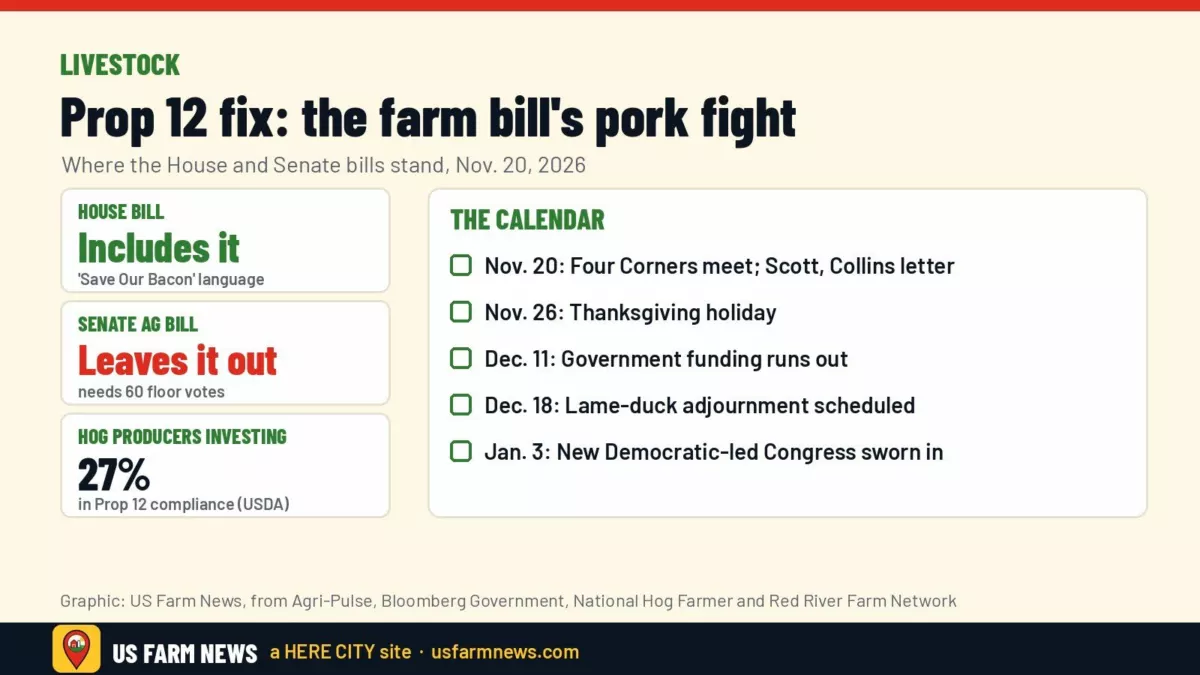
- Republican Sens. Rick Scott and Susan Collins told the farm bill’s lead negotiators on Nov. 20 to leave out the House’s “Save Our Bacon” fix to California’s Proposition 12.
- The letter landed the same day the Four Corners committee leaders met to work through House-Senate differences before the Thanksgiving break.
- About three working weeks remain in the lame-duck Congress, which is set to adjourn Dec. 18; government funding runs out Dec. 11.
- USDA figures shared with the House Agriculture Committee show 27% of U.S. hog producers have made or are making Prop 12 compliance investments.
The fight over California’s Proposition 12 has become one of the last big obstacles to a five-year farm bill, and it just picked up two Republican opponents in the Senate. Florida’s Rick Scott and Maine’s Susan Collins sent a letter on Friday, Nov. 20, urging House Agriculture Chairman Glenn Thompson of Pennsylvania and Senate Agriculture Chairman John Boozman to drop the House’s “Save Our Bacon” language, according to Agri-Pulse and Bloomberg Government, which both obtained the letter.
The two senators called the provision “dangerous federal overreach.” Their letter arrived as the Four Corners, the Republican chairs and top Democrats on the two agriculture committees, met to sort out the remaining differences between the House and Senate bills, Agri-Pulse reported, citing people familiar with the meeting.
Why it matters for hog producers
Prop 12, approved by California voters in 2018 and fully in force since 2024, sets housing standards for hogs whose pork is sold in California, wherever the animals are raised. Massachusetts has a similar law, known as Question 3.
That decision has real money behind it. Agri-Pulse reported that USDA, in a letter to the House Agriculture Committee, put the share of U.S. pork producers who had invested or were investing in Prop 12 compliance at 27% as of last year. That split is why the outcome matters on both sides of the barn door: some operations have already spent money to meet the California standard, while most have not.
What the House bill would do
The House-passed farm bill would give states a “federal right” to interstate commerce and bar a state from imposing its livestock housing rules on farms in other states. The Senate Agriculture Committee’s bill, which has not had a floor vote, leaves the language out.
Boozman has called the provision too divisive and a risk to full Senate passage, though he has said he supports adding it later in the process, Agri-Pulse reported. Thompson has made clear he wants it in the final bill. The Senate bill needs 60 votes on the floor, National Hog Farmer noted, which makes every defection on either side count.
Scott and Collins framed their objection around states’ rights. “Congress should not strip states of that authority or allow Washington to dictate agricultural policies across the country,” they wrote, as quoted by Agri-Pulse.
The National Pork Producers Council, which is pressing to keep the language in a final bill, rejected that argument. “Fixing California Proposition 12 is not about taking away states’ rights. It’s about protecting them,” the group said in a statement to Agri-Pulse, adding that the Supreme Court has said Congress has the authority to act.
The rest of the farm bill math
Prop 12 isn’t the only open question. National Hog Farmer listed two other main disputes: when states must start sharing SNAP costs and year-round E15; Boozman backs delaying SNAP cost-sharing by at least a year, while Democrats want two. A Senate Agriculture Committee spokesperson told Agri-Pulse only that discussions with the House “are ongoing.”
The calendar is unforgiving. Democrats won both chambers in the Nov. 3 midterms and take control when the new Congress is sworn in Jan. 3, National Hog Farmer reported. President Trump has urged Republicans to pass a farm bill before then, saying farmers need certainty ahead of 2027 planting, according to Red River Farm Network. American Soybean Association President Scott Metzger put the odds of a bill this year at 60%, telling Red River Farm Network that “the four corners want to get it done.”
If the bill slips into next year, National Hog Farmer said, Save Our Bacon would face a tougher path under Democratic majorities. For background, see our coverage of what the Democratic takeover means for the farm bill and the SNAP and E15 fight.
What to watch
- After Thanksgiving: Whether the Four Corners announce a framework, and whether Prop 12 language is in or out.
- Dec. 11: Government funding deadline; watch for farm bill or E15 provisions riding on a year-end spending bill.
- Dec. 18: Scheduled lame-duck adjournment.
- For hog farms: Hold off on major barn decisions that hinge on Prop 12’s fate until the final bill text is public, and ask your packer how a federal override would change its Prop 12 premiums and contracts.
Get the Daily Ag Business Briefing
Markets, policy and farm business in one free email each weekday.