A HERE CITY site

Prevented Planting 5% Buy-Up Is Back for 2027: How to Elect It Before Your Sales Closing Date
RMA has set rules to reinstate the 5% prevented planting buy-up starting with 2027 corn and soybeans. It isn't automatic. Here's how to elect it in time.
Key takeaways
- USDA’s Risk Management Agency (RMA) told crop insurance companies on Nov. 20 how to restore the prevented planting +5% buy-up, known on policies as PF, which was dropped a year ago.
- For crops with a Nov. 30, 2026 contract change date, which includes corn and soybeans, the option returns for the 2027 crop year. For all other crops, the bulletin says it returns in 2028.
- It is not automatic. You have to elect it on an application or a policy change form, no later than your sales closing date.
- Growers who carried PF the last time it was offered are treated as reinstatements; everyone else is a new request that the insurance company can deny.
Farmers who lost the extra 5% of prevented planting coverage last year can get it back, but only if they ask for it in time. In a bulletin dated Nov. 20, RMA told approved insurance providers how to reinstate the PF option and how to tell a returning customer from a new request. The details are also spelled out in RMA’s 2027 Prevented Planting Standards Handbook, published this month.
Why it matters to your bottom line
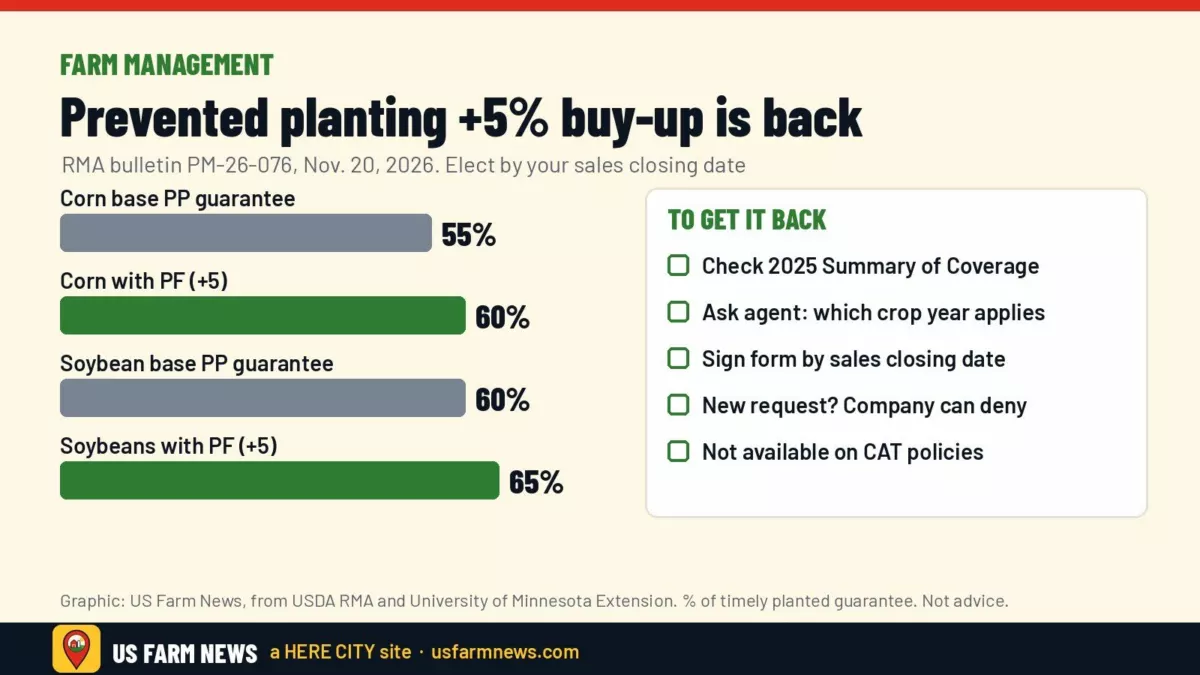
Prevented planting (PP) pays when an insured cause such as flooding keeps you from planting by the final planting date. The base PP guarantee is a percentage of your timely planted guarantee: 55% for corn and 60% for soybeans, according to University of Minnesota Extension. The PF option adds 5 percentage points for an extra premium, so corn would go to 60% and soybeans to 65%.
That gap has been worth real money in wet years. From 2010 through 2024, prevented planting indemnities on policies with the buy-up totaled $5.31 billion for corn alone, with North Dakota and South Dakota receiving the most, according to an analysis by North Dakota State University’s Agricultural Risk Policy Center. Between 2018 and 2024, about $329 million of corn PP payments was attributable to the 5% buy-up itself, the center found.
How we got here
- Nov. 2025: RMA dropped PF beginning with crops whose contract change date fell on Nov. 30, 2025, under its Expanding Access to Risk Protection (EARP) rule, according to the Nov. 20 bulletin.
- Aug. 5, 2026: RMA announced it would bring PF back. “We are providing producers additional flexibility when they need it most,” RMA Administrator Pat Swanson said in the announcement.
- Nov. 20, 2026: RMA issued bulletin PM-26-076 with the reinstatement rules for insurance companies.
Swanson, an Iowa farmer and former crop insurance agent, told Southern Farm Network the agency heard a lot of feedback after the option was removed and that farmers have to weigh their own risk against the added premium.
Which crops and which year
The bulletin says PF comes back starting with crop year 2027 for crops whose policies have a Nov. 30, 2026 contract change date, and starting in crop year 2028 for all other crops. Under the federal coarse grains crop provisions, the contract change date for corn, grain sorghum and soybeans is Nov. 30 before the cancellation date, and that cancellation date is March 15 in most states, with earlier dates in Texas and much of the South.
RMA’s August announcement had described the restart as beginning with crops tied to an Aug. 31, 2026 date. Because the two documents describe timing differently for some crops, ask your agent to confirm the year PF is available for each crop you insure.
How to get it back: step by step
- Find your last Summary of Coverage. For corn and soybeans, check whether you carried PF in crop year 2025. For other crops, the look-back year is 2026. RMA lists the Summary of Coverage, company records and its Policy Holder Tracking System as ways to verify prior coverage.
- Call your agent before the sales closing date. Your election has to be on an application or a policy change form, submitted no later than the sales closing date for the 2027 (or 2028) crop year. Ask for your exact date by county and crop.
- Sign the form; don’t assume. Reinstatement requires a new election even if you had the option for years.
- If you never had PF, expect a review. New requests go through the company’s usual checks to make sure no cause of loss that could prevent planting had already occurred. Under the 2027 handbook, a request is treated as approved unless the company denies it in writing within 60 days after the sales closing date.
- Watch entity changes. The handbook says an election from a new entity counts as a new request, not a reinstatement, so a farm that reorganized may not qualify as a returning customer.
- Check coverage type. PF requires additional (buy-up) coverage. It isn’t available on catastrophic (CAT) policies, according to the handbook.
Is it worth the premium?
That depends on how often your ground is too wet to plant. Historically, North Dakota and South Dakota have collected the most buy-up PP payments on corn and soybeans, while rice payments were concentrated in Arkansas and California, the NDSU analysis found. Ask your agent for the per-acre premium for PF on each unit and compare it with the added guarantee: 5% of your per-acre production guarantee times the projected price. Our guides to 2027 SCO and ECO changes and the 2027 ARC/PLC sign-up cover the other decisions you’ll make in the same window.
This article is general information, not legal, tax, or financial advice. Confirm your eligibility, dates and premiums with a licensed crop insurance agent.
Frequently asked questions
Will my insurance company add the 5% prevented planting option automatically?
No. You have to elect PF on an application or a policy change form by the sales closing date for that crop year, even if you carried it before.
What if I never had the PF option?
Your request is treated as new. The insurance company checks whether a cause of loss that could prevent planting has already occurred, and the request stands unless the company denies it in writing within 60 days after the sales closing date.
How much does PF add?
It adds 5 percentage points to the prevented planting guarantee, for example from 55% to 60% for corn, in exchange for additional premium.
Get the Daily Ag Business Briefing
Markets, policy and farm business in one free email each weekday.