A HERE CITY site

Growing Wheat in 2027 Will Cost a Record $446 an Acre, USDA Forecasts; Growers Say Break-Even Is 70 Bushels
USDA forecasts 2027 wheat costs at $445.77 an acre, and South Dakota growers say break-even is about 70 bushels. See the cost lines and how to run your own.
Key takeaways
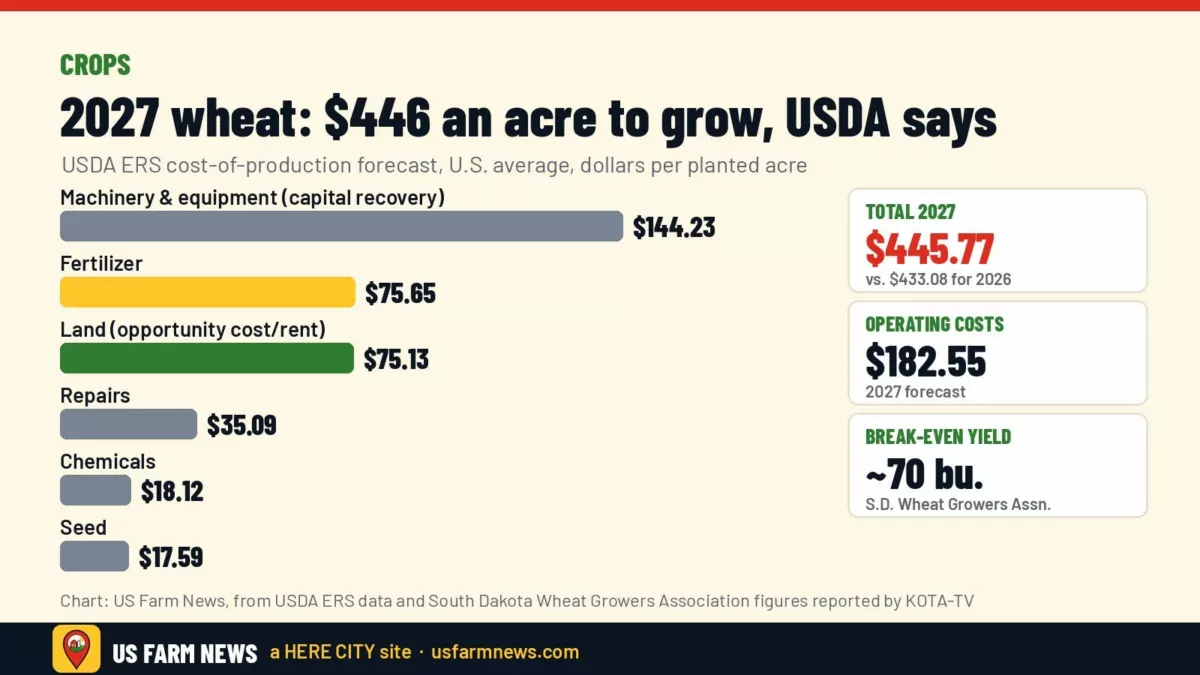
- USDA’s Economic Research Service (ERS) now forecasts the full cost of growing an acre of U.S. wheat at $445.77 in 2027, up from $433.08 projected for 2026.
- The South Dakota Wheat Growers Association said on Nov. 21 that 2027 wheat costs could run 45% above a decade ago and put the break-even yield at roughly 70 bushels an acre.
- Machinery ownership, not fertilizer, is the biggest single line in the ERS wheat budget at $144.23 an acre; fertilizer is forecast at $75.65, about flat with 2026.
- American Farm Bureau Federation economists said USDA’s update shows each major field crop reaching a record per-acre cost next year.
Wheat growers heading into 2027 are looking at the most expensive crop budget USDA has ever forecast for them, and a South Dakota farm group says the math no longer works at typical yields. The South Dakota Wheat Growers Association said Saturday that new USDA forecasts put 2027 wheat production costs as much as 45% higher than ten years ago, KOTA-TV in Rapid City reported. By the group’s math, a grower would have to harvest roughly 70 bushels an acre just to cover costs, and it is pressing for farm policy that reflects current input prices.
That 70-bushel figure is well above the 53.3-bushel national average the association cited as last year’s record, according to KOTA.
Why it matters to your bottom line
Winter wheat is already in the ground and spring wheat inputs are being priced now, so 2027 margins are being set this winter. When the cost of an acre climbs while yields and prices don’t, the gap shows up in working capital, in operating loan renewals and in how much rent a farm can afford to bid.
What USDA’s forecast shows
The ERS cost-of-production forecast, updated in November, lists these per-acre costs for U.S. wheat in 2027:
- Operating costs: $182.55, including fertilizer at $75.65, repairs at $35.09, chemicals at $18.12, seed at $17.59, custom work at $17.27 and fuel, lube and electricity at $14.79.
- Allocated overhead: $263.22, led by the capital recovery charge on machinery and equipment at $144.23 and the opportunity cost of land (a rental rate) at $75.13.
- Total, all costs listed: $445.77, versus $433.08 forecast for 2026, an increase of nearly $13 an acre, or roughly 3%.
The association said fertilizer is the biggest reason costs are up over the past decade, KOTA reported. In the year-to-year ERS numbers, though, wheat fertilizer is essentially unchanged from 2026 ($75.66), while machinery recovery, repairs and land costs rise. Fuel is one of the few items forecast to fall.
The forecast moved higher during the fall. Compared with its June projection, USDA raised its 2027 wheat estimate by about $18 an acre, or 4%, AFBF economist Faith Parum wrote in a Farm Bureau Market Intel analysis. RFD-TV reported that USDA lifted projected fertilizer costs across crops by about 14% for 2027 versus June, and both outlets pointed to energy markets, war and conflict tied to Russia, Ukraine and Iran, and the risk to tanker and cargo traffic through the Strait of Hormuz.
How wheat compares with other crops
Wheat has the lowest per-acre cost of the major crops in USDA’s list, but it also tends to generate the least revenue per acre. According to the ERS forecast, 2027 totals run about $984 for corn, $714 for soybeans, $487 for sorghum, $550 for barley and $544 for oats. Farm Bureau said USDA now expects each of the major field crops to hit a per-acre cost record next year and that the projected costs exceed the highs of the early 2020s inflation spike.
Run your own break-even
USDA’s figure is a national average that includes costs many farms never write a check for, such as the value of unpaid family labor and a rental charge on owned land. A working break-even for your own farm takes a few steps:
- Split cash and full costs. Operating costs ($182.55 in the ERS budget) are closest to what you’ll finance. Add your actual rent or land payment, insurance and machinery payments to get a cash break-even.
- Divide by realistic yield. Use your own multi-year average, not a best year. Using USDA’s full $445.77, the break-even works out to about $7.43 a bushel at 60 bushels an acre and about $6.37 at 70, which shows how much the yield assumption matters.
- Price the inputs you haven’t bought. Fertilizer is the largest operating line. Our recent look at anhydrous and phosphate prices this fall shows where those quotes stand.
- Compare to your marketing plan. Check new-crop bids and crop insurance projected prices against the break-even before you lock in more inputs or rent.
Our 2027 cash-flow planning guide covers how to build those numbers into a budget your lender will accept.
What to watch
- USDA’s Dec. 10 supply and demand update; Brownfield noted global demand for U.S. wheat has been slow, though some classes are becoming more price-competitive.
- Details of USDA’s Harvest Fuel Relief Program, which Farm Bureau said is expected to ease some of the fuel cost pressure; program details have not yet been released.
- Whether farm groups’ calls for updated reference prices and other policy changes gain traction in the new Congress.
Get the Daily Ag Business Briefing
Markets, policy and farm business in one free email each weekday.