A HERE CITY site

WheatAI Aims to Count Wheat Heads From 10 to 20 Phone Photos; SDSU Plans a Free Launch in 2028
SDSU's free WheatAI reads phone and drone photos to estimate wheat yield potential and Fusarium damage. Until its 2028 launch, here's the hand method.
Key takeaways
- South Dakota State University is building WheatAI, a web tool that reads smartphone and drone photos of wheat to measure plant traits, estimate yield potential and assess disease.
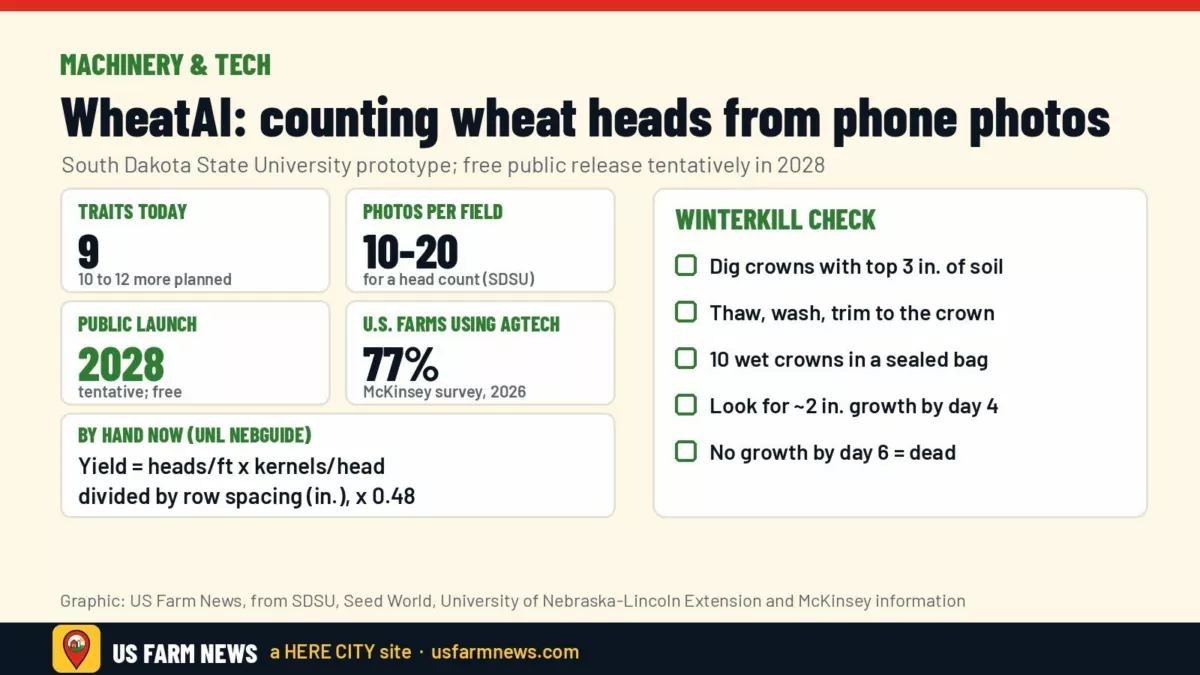
- The prototype handles nine traits today; the team plans to add 10 to 12 more before a public release, tentatively in 2028.
- Researchers say it will be free. For farmers, the pitch is a head count per square foot from 10 to 20 field photos, plus help scoring Fusarium-damaged kernels.
- Until then, the hand-count methods extension services have long published still work, and this winter is a good time to check stands for winterkill.
Counting wheat heads in a few spots and multiplying out a yield guess is one of the more tedious jobs in a wheat field. Researchers at South Dakota State University want a phone camera and artificial intelligence to do it. Their tool, WheatAI, is designed to measure wheat traits from ordinary smartphone and drone images, estimate yield potential and help assess disease, including damage from Fusarium fungi, the university said in a Nov. 12 release. Seed World covered the project on Nov. 20.
It isn’t something you can use this season. The researchers put a tentative public launch in 2028. But it is a useful example of where farm AI is heading: narrow tools that do one measurement well, built on local field photos, and offered free.
How WheatAI was built
Wheat breeder Sunish Sehgal started photographing winter wheat in 2022, according to SDSU. The image set came from five points in the season between May and July, taken at the university’s Pierre and Brookings research farms and in growers’ fields near Winner and Hayes, S.D. In 2025, Sehgal teamed up with Maitiniyazi Maimaitijiang, an assistant professor of geography and geospatial sciences who works on remote sensing and computer vision, and graduate students to build a working prototype.
Today the prototype measures nine traits. The team intends to add 10 to 12 more traits before release and is also exploring whether the tool can measure stomata, the tiny pores that control gas exchange and water loss.
What it could do for a farmer
The breeding payoff is speed and consistency. Two people scoring the same diseased wheat head may give it different ratings, SDSU noted, while Sehgal said “the camera always looks at it the same.” For growers, SDSU described three possible uses:
- Yield potential: Take 10 to 20 photos across a large field, upload them and get an automated count of heads per square foot.
- Crop decisions: An earlier, better-grounded call on whether a stand is worth taking to grain or should be cut for silage.
- Grain quality: Help assessing Fusarium-damaged kernels in harvested wheat.
The university was careful about limits. How good the answer is will depend on whether the photos represent the whole field and on how accurately the model counts heads, SDSU said. That’s the same caution that applies to any AI tool: a confident number from a few unrepresentative photos is still a guess.
Where farmers stand on AI tools
Farm adoption of digital tools is already common. McKinsey’s 2026 Global Farmer Insights survey of 5,500 farmers in 10 countries, as described in a Nov. 20 McKinsey report, found 77% of U.S. farmers use at least one agtech product, compared with a global average of 46%. Use of generative AI for farm tasks was much lower, at 17% globally, with most users applying it to planning and crop management. Free, single-purpose tools like WheatAI could make it easier to try AI without a subscription.
For more on vetting farm AI, see our checklist for AI assistants in farm software.
Until 2028: estimating wheat yield by hand
University of Nebraska-Lincoln Extension’s NebGuide on estimating winter wheat yields lays out a formula that it says many Nebraska hail adjusters use:
- Count heads per foot of row at five or more representative sites, using at least 5 feet of row at each.
- Count kernels per head on at least five heads per site. UNL says Nebraska winter wheat averages about 22, and that number should come down for a struggling crop.
- Measure row spacing in inches.
- Yield (bu/acre) = (heads per foot × kernels per head ÷ row spacing) × 0.48. In UNL’s example, 30 heads per foot, 22 kernels per head and 12-inch rows work out to 26.4 bushels an acre.
The guide stresses that these are estimates that assume healthy plants, adequate moisture and good weed control and fertility, and that growers should check with their crop insurance provider and local FSA office before destroying a wheat stand.
A winter task you can do now: UNL’s guide also describes checking dormant wheat for winterkill. Dig the top 3 inches of soil with crowns, thaw and wash the plants, cut the top growth back to about an inch above the crown and remove the roots below it, and keep 10 wet crowns in an inflated, sealed plastic bag in a lighted room out of direct sun. After about four days, live crowns should show about 2 inches of new growth; plants not growing after six days should be counted as dead. Winterkill can be very localized, so sample carefully.
What to watch
SDSU says WheatAI will be released at wheatai.net, tentatively in 2028. Watch for the added traits, any published accuracy results against hand counts, and whether the team opens field testing to growers before launch. For this year’s wheat economics, see our report on USDA’s wheat cost-of-production forecast.
Get the Daily Ag Business Briefing
Markets, policy and farm business in one free email each weekday.