A HERE CITY site

Thin Farm Year? Why Reporting More Income in 2026 Could Save Tax, and the Moves That Work Either Way
In a low-income 2026, selling grain or electing out of installment sales can pull income into a cheaper tax year. What farmdoc and the IRS guide say.
Key takeaways
- With 2026 farm incomes projected to stay low, University of Illinois farm management specialists say tax planning can be more valuable in a weak year, not less.
- If 2027 looks better than 2026, moves such as selling grain before Dec. 31 or electing out of the installment method on deferred contracts can pull income into the lower-tax year.
- Remember what’s taxable in 2026: Farmer Bridge Assistance payments and 2025 ARC/PLC payments, farmdoc daily notes.
- Very low income has costs: income below the standard deduction goes untaxed but is wasted, and a self-employment loss doesn’t carry forward.
Most year-end farm tax advice is about cutting this year’s bill. For a lot of grain farms in 2026, that may be the wrong goal. Lower yield forecasts across much of Illinois and higher costs point to a thin year for many operations, and University of Illinois specialist Bradley Zwilling argues in a Nov. 20 farmdoc daily article that strategic planning may be worth more when incomes are down. The reason: if next year’s income will be higher, you may come out ahead by reporting more income now and paying tax on it at lower rates.
Here’s how to tell which direction you need, and the tools on each side, drawn from farmdoc daily and IRS Publication 225, the Farmer’s Tax Guide.
Step 1: Figure out where 2026 is headed
Zwilling recommends starting with goals (debt reduction, retirement, expansion or simply keeping more after tax) and then with records. Before you meet your preparer:
- Inventory grain and livestock on hand, noting what’s already priced and putting a value on what isn’t.
- List income and expense items you could still move before Dec. 31.
- Lay out three tax years side by side: last year’s return, an estimate for 2026 and a projection for 2027.
Watch the 2026-specific items. According to farmdoc daily, Farmer Bridge Assistance Program payments and 2025 ARC/PLC payments both count as 2026 taxable income. Payments tied to the 2026 crop from Enhanced Coverage Option policies may not be known until spring or early summer of 2027. And because many farms bought less machinery this year, there may be less depreciation to work with.
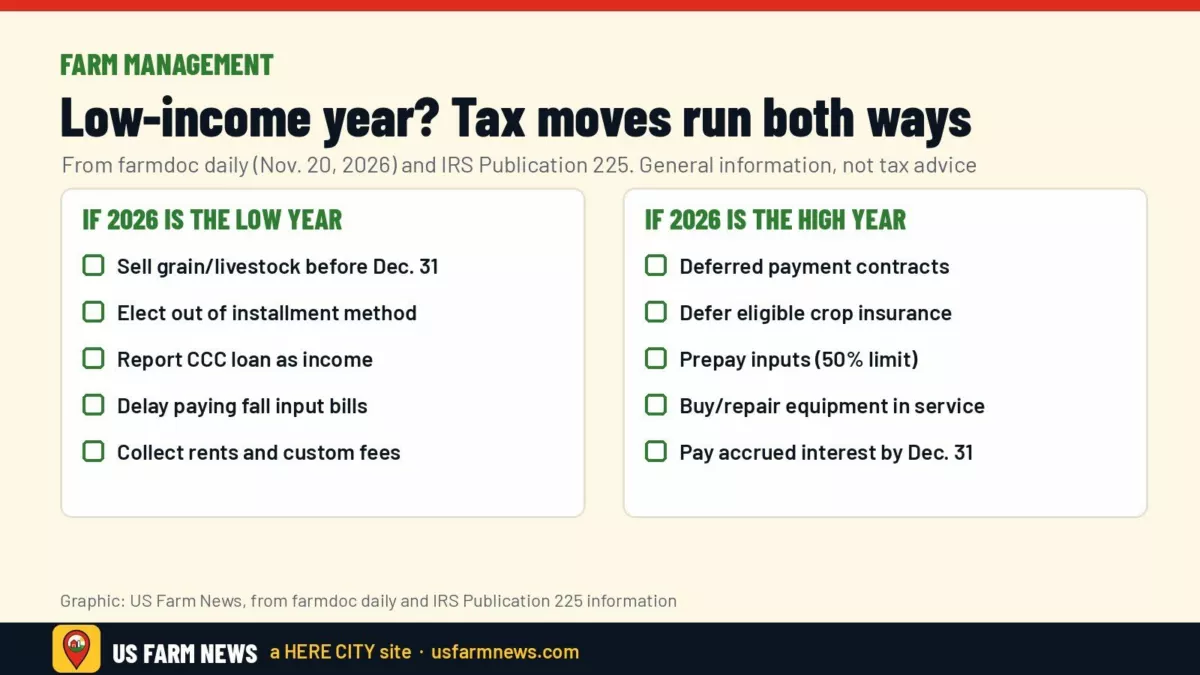
Step 2 (if 2026 is the low year): ways to raise taxable income
farmdoc daily lists several options when this year’s income is unusually low and next year’s is expected to be higher:
- Sell crops and livestock in 2026 instead of carrying them into 2027.
- Elect out of the installment method on deferred payment contracts, so the sale counts as 2026 income even though you collect the cash in 2027.
- Take a CCC marketing loan and elect to report it as income. IRS Publication 225 explains that you make this election by including the loan proceeds on Schedule F for the year received and attaching a statement with the loan details. The amount reported becomes your basis in the commodity.
- Hold off on paying fall input bills for seed, fertilizer, lime and fuel, starting with bills that carry no cash discount or only small finance charges.
- Depreciate lime and heavy fertilizer applications rather than deducting them all this year.
- Collect custom work fees, rents and other money owed to you before year-end.
- Take gains on off-farm investments if you were weighing a sale anyway.
Why an overly low year costs you
farmdoc daily flags three traps when income drops too far:
- Income up to the standard deduction is effectively taxed at a 0% federal rate. If you fall short of it, that deduction is simply lost.
- A negative self-employment income figure does not carry forward to offset self-employment income in later years.
- Low or negative income can put deductions at risk, including retirement contributions and the self-employed health insurance write-off, and can create a loss for the Qualified Business Income Deduction.
Step 2 (if 2026 is the high year): ways to lower it
Some farms will have a strong 2026 thanks to good yields, good prices or deferred 2025 crop insurance money. For them, farmdoc daily’s list runs the other way:
- Deferred payment contracts. Lock in a sale this year and take payment next year. IRS Publication 225 warns that this works only for a genuine contract calling for payment in a later year; if the contract gives you the right to the money any time after delivery, the sale is 2026 income regardless of when you’re paid.
- Deferring crop insurance proceeds. Under Publication 225, cash-method farmers who receive insurance money in the year of the damage can postpone reporting it to the next year if they can show they normally would have reported more than half the income from that crop in a later year. For revenue policies, only the part caused by yield loss can be deferred.
- Prepaying next year’s inputs. Publication 225 says cash-method deductions for prepaid farm supplies can be limited to half of the year’s other deductible Schedule F expenses, with some exceptions.
- Buying equipment or making big repairs now. For Section 179 or bonus depreciation, the machine must be available for service before year-end, farmdoc daily notes. The 2025 tax law set bonus depreciation at 100% and the expense election at $2.5 million, according to the article. Our earlier guide to Section 179 and prepaid inputs has more detail.
- Paying accrued interest through Dec. 31. Prepaid interest, insurance and cash rent are not deductible, farmdoc daily cautions.
- Setting up a retirement plan. According to farmdoc daily, traditional, Roth and SEP IRAs can still be opened up until the return’s due date.
Don’t forget the January deadline
Farmers whose gross income comes at least two-thirds from farming qualify for special estimated tax rules. For the 2025 tax year, Publication 225 says a qualified farmer had to either make an estimated payment by Jan. 15, 2026, or file and pay in full by March 2, 2026, to avoid a penalty. Check the corresponding dates for your 2026 return with your preparer.
For a broader look at next year’s cash needs, see our guide to building a 2027 cash-flow plan.
This article is general information, not legal, tax, or financial advice. Tax rules have conditions and exceptions; talk with a qualified tax preparer about your operation before acting.
Frequently asked questions
Why would a farmer want more taxable income?
If this year’s income is unusually low and next year’s will be higher, reporting more income now can mean paying tax on it at lower rates, and it avoids wasting deductions such as the standard deduction, according to farmdoc daily.
Are Farmer Bridge Assistance payments taxable in 2026?
Yes. farmdoc daily says FBA payments, along with 2025 ARC/PLC payments, count as 2026 taxable income.
Can I defer crop insurance money to next year?
Sometimes. IRS Publication 225 allows cash-method farmers to postpone eligible proceeds if they normally would have reported more than half of that crop’s income in a later year. Only the yield-loss part of a revenue policy payment qualifies.
Get the Daily Ag Business Briefing
Markets, policy and farm business in one free email each weekday.