A HERE CITY site

Retired Generals Say China Is Using Sulfur as a Weapon and Urge Trump to Use the Defense Production Act on Fertilizer
Twelve retired officials say China bids up U.S. sulfur and curbs phosphate exports, and urge a fertilizer strategy as MAP hits $995 a ton at retail.
Key takeaways
- Twelve retired military and national security officials asked President Trump on Nov. 20 to treat fertilizer supply, and sulfur in particular, as a national security issue.
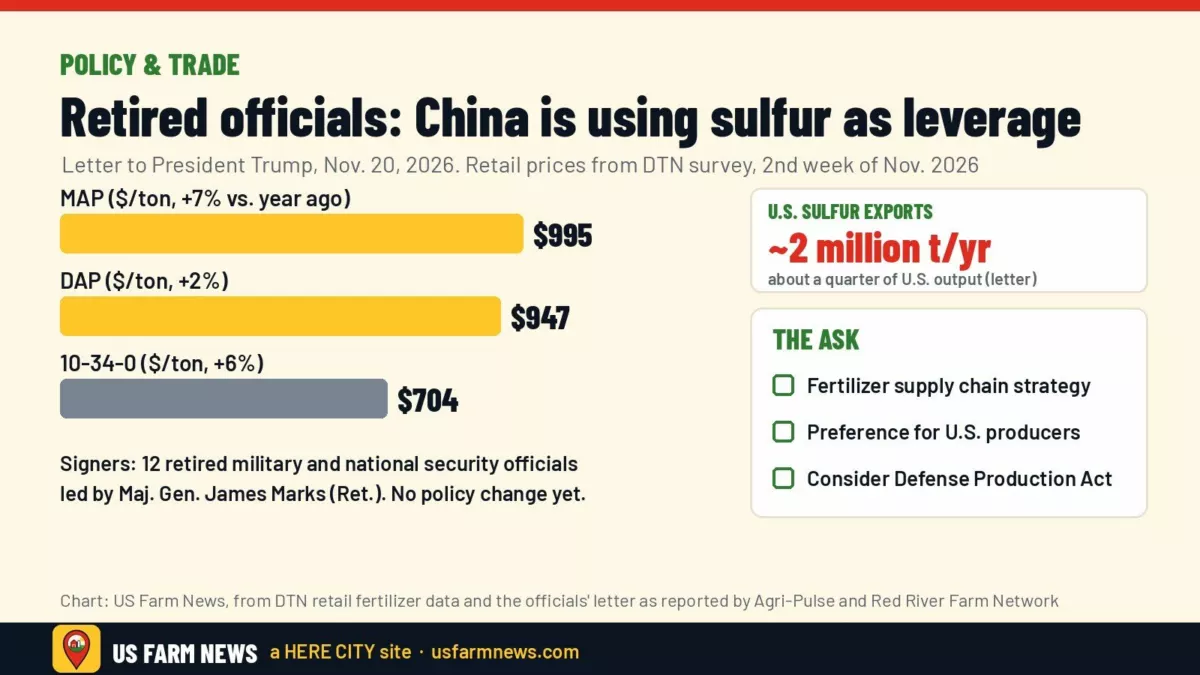
- By their count, close to 2 million metric tons of U.S. sulfur is shipped overseas annually, roughly one-fourth of what the country produces, and much of it ends up in Chinese phosphate plants.
- The group backs using the Defense Production Act and favoring U.S. fertilizer makers. The letter is a request and doesn’t change policy on its own.
- Phosphate is already pricey: DTN’s retail survey put MAP at $995 a ton and DAP at $947 in the second week of November.
A dozen retired generals, admirals and former defense officials want the Trump administration to step into the fertilizer market. In a letter sent Nov. 20 to the president and members of his Cabinet, Agriculture Secretary Brooke Rollins and trade chief Jamieson Greer among them, the group argues that China is turning sulfur, the raw material phosphate plants depend on, into leverage over American farms and grocery bills.
The letter is a request, not a policy change. Nothing in it changes what a farmer pays for phosphate this winter. But it adds a national security argument to an input-cost fight that farm groups have been waging for months, and it lands just as growers lock in 2027 fertilizer plans.
What the officials are asking for
Retired Army Maj. Gen. James “Spider” Marks organized the letter, according to a release from the group and reporting by Agri-Pulse. The signers want the administration to:
- Write a supply chain security strategy for fertilizer.
- Give U.S. fertilizer manufacturers preference for domestic inputs, chiefly American-produced sulfur, Red River Farm Network reported.
- Expand fertilizer manufacturing at home and treat critical farm inputs as a national security priority.
- Consider the Defense Production Act, which lets a president put certain goods at the front of the line. The officials noted that some lawmakers have already floated that idea.
“China is using sulfur, a key input for fertilizer, as a weapon,” the signers wrote. Marks told Agri-Pulse that the DPA could bring relief on sulfur prices and shore up domestic fertilizer output.
Why sulfur matters to your phosphate bill
Most farmers never buy sulfur by the ton for this purpose, but they pay for it anyway. Sulfur is a key ingredient in processing phosphate, the source of the phosphorus in products such as MAP and DAP, so a sulfur price spike works its way into the phosphate bill.
According to the officials, the U.S. makes roughly two-thirds of the sulfur and sulfuric acid it needs, yet close to 2 million metric tons of U.S. elemental sulfur leaves the country every year. They say much of it is bought by subsidized, state-backed Chinese companies that outbid U.S. buyers, turn the sulfur into phosphate fertilizer and then limit exports of that finished product. The result, in their words, is that U.S. farmers and families “pay twice”: once for the bid-up input and again for tighter global fertilizer supplies.
The group also pointed to the conflict around the Strait of Hormuz, saying it has already squeezed supply. Agri-Pulse noted a recent jump in sulfur prices is adding to farm input inflation. Those characterizations of Chinese buying come from the letter’s authors; the Chinese government’s response was not included in the coverage we reviewed.
Where fertilizer prices stand
DTN’s weekly survey of retailers for the second week of November found all eight major fertilizers priced above a year earlier. The phosphate numbers:
- MAP: $995 a ton, 7% above a year ago.
- DAP: $947 a ton, 2% above a year ago.
- 10-34-0: $704 a ton, 6% higher than last year.
- Anhydrous: $997 a ton, up 16% from a year earlier.
DTN also cited the American Farm Bureau Federation’s finding that USDA’s latest cost forecasts went up for all the major field crops, for this year and next, with fertilizer the main reason. For background on the nitrogen side, see our earlier look at anhydrous prices and the phosphate outlook for 2027, and our report on USDA’s record 2027 wheat cost forecast.
What it means for your farm
A DPA order or export restriction on sulfur, if it ever came, would take time to reach retail prices, and the letter gives no timeline. For spring 2027 planning, it makes sense to budget on today’s prices rather than on hoped-for relief:
- Price phosphate per pound of P2O5, not per ton, before you compare MAP, DAP and liquid options.
- Lean on current soil tests and your agronomist to decide which fields get phosphate first if you need to trim the budget.
- Ask your retailer about supply, not just price, before you book spring needs.
- Watch Washington. Any move on the letter would most likely come from the White House or the Commerce or Agriculture departments.
What to watch
The letter arrives in a busy stretch for farm policy, with Congress trying to finish a farm bill before the lame-duck session ends and fertilizer costs a recurring theme in farm group lobbying. Watch for any response from USDA or the White House, for lawmakers formally pushing DPA language, and for DTN’s weekly retail prices to see whether phosphate keeps climbing into the winter booking season.
Get the Daily Ag Business Briefing
Markets, policy and farm business in one free email each weekday.