A HERE CITY site

Nogales Port Reopens to Mexican Cattle Nov. 30 as U.S. Screwworm Cases Reach 170: What Cattle Markets Should Watch
USDA reopens Nogales, Ariz., to Mexican cattle Nov. 30, the fourth border port back since August, as U.S. screwworm cases hit 170 and Arizona confirms nine.
Key takeaways
- USDA plans to reopen the Nogales, Arizona, port to cattle from Mexico on Monday, Nov. 30, the fourth southern crossing back in service since August.
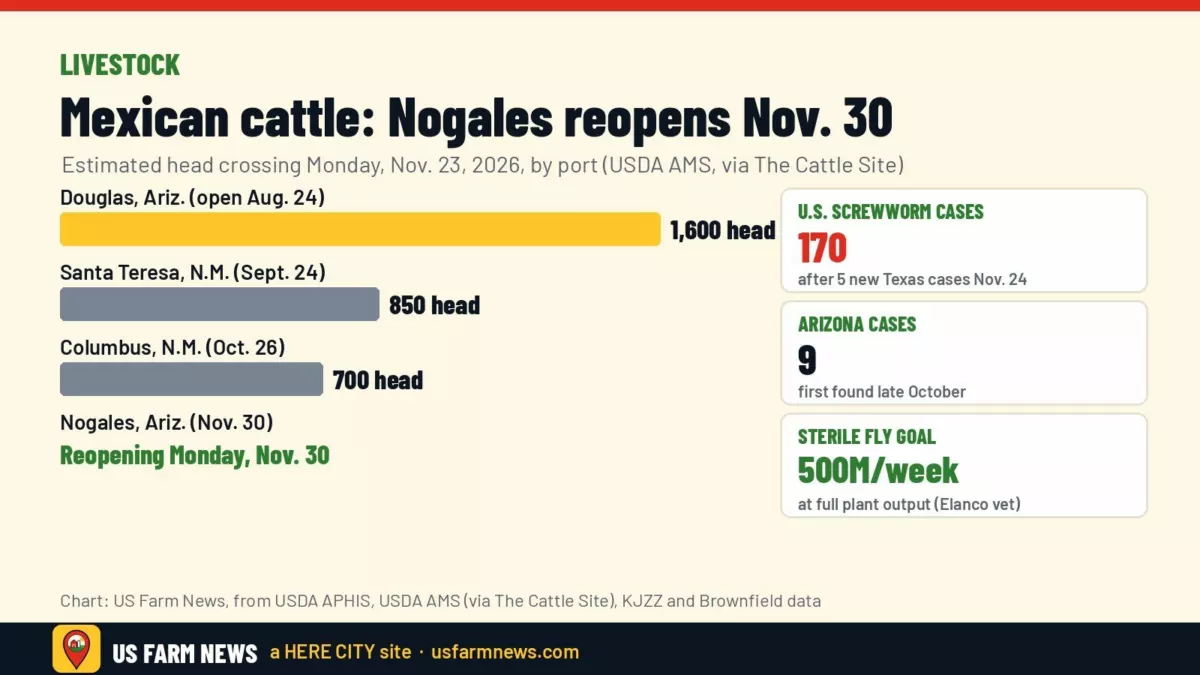
- About 3,150 head of Mexican cattle came through the three open ports on Nov. 23, led by Douglas, Ariz., with roughly 1,600, according to USDA estimates reported by The Cattle Site.
- Screwworm cases keep rising: the U.S. count reached 170 after five new Texas cases on Nov. 24, and Arizona has confirmed nine.
- A veterinarian told Brownfield that new plants able to produce all-male sterile flies could eventually push output to about 500 million flies a week.
Mexican feeder cattle are about to get another way into the United States. USDA’s Animal and Plant Health Inspection Service lists Nogales, Arizona, as reopening to cattle imports on Nov. 30, after a shutdown of more than a year imposed to keep the New World screwworm out. KJZZ reported on Nov. 27 that Sonora’s governor, Alfonso Durazo, has confirmed his state’s ranchers will begin trailing cattle on foot through the Nogales crossing.
The reopening comes while the pest is still spreading on the U.S. side of the border. That leaves stocker operators, feedlots and cow-calf producers weighing two things at once: a little more feeder supply from the south, and a disease that hasn’t been contained yet.
Why it matters for cattle prices and feedlot supply
Each reopened crossing adds a few more feeder animals to the supply. USDA’s Agricultural Marketing Service estimated that about 3,150 head crossed on Monday, Nov. 23, The Cattle Site reported: roughly 1,600 through Douglas, Ariz., 850 at Santa Teresa, N.M., and 700 at Columbus, N.M.
So far those numbers haven’t jolted the market at the border. At all three crossings, prices for steer calves and yearlings were unchanged from a week earlier, according to the same AMS report. Heifer prices were also steady at Douglas and Santa Teresa. At Columbus, heifer trade was too thin to set a trend.
Nogales would be the second Arizona crossing open to cattle this year, after Douglas. When Agriculture Secretary Brooke Rollins announced the date during an October visit to Nogales, she said the facilities there had added inspection equipment, dog teams and dipping vats, KGUN reported. She called the pest something USDA is “managing” while adding that “we’re not out of the woods yet.”
The reopening timeline
- Douglas, Ariz.: Aug. 24, 2026
- Santa Teresa, N.M.: Sept. 24, 2026
- Columbus, N.M.: Oct. 26, 2026
- Nogales, Ariz.: Nov. 30, 2026 (planned)
APHIS says it will keep judging other ports one at a time, based on animal health risk, whether inspection staff and facilities are ready, and how well its safeguards are working. Every other southern border port remains closed to livestock. APHIS made the Nogales date conditional from the start: it said the crossing would open on schedule only if conditions still supported safe trade and the required inspection setup was in place.
Cases are climbing as the weather cools
The disease picture got worse in November. APHIS confirmed five more cases in Texas cattle on Nov. 24, three of them in Brewster County and one each in Cameron and Webb counties, The Cattle Site reported. That brought the U.S. total to 170: 168 in livestock and pets, plus two found in wild or feral animals. Of the domestic cases, 92 were still active. November alone accounted for 83 confirmed cases, and 81 of those were still active at the time of the report.
Arizona has confirmed nine cases since the pest first showed up there in late October, according to KJZZ, and Sonora reports more than 70 active cases. Santa Cruz County, Arizona, where the Nogales crossing sits, had no confirmed cases, according to The Cattle Site.
Dr. M. Wayne Ayers, a technical consultant for Elanco, told Brownfield the summer heat had slowed the spread. Now that temperatures have eased, he said, more cases were expected. The bigger problem is fly supply. Sterile male flies are how the pest was wiped out the first time. But with only so many available, Ayers said, they get spread thinner as the infested area grows.
The sterile fly fix, and how long it may take
Ayers told Brownfield that new production plants will use a genetic technique that keeps females from developing, so every fly produced is a male. He said that essentially doubles each plant’s capacity. At full output, he estimated, the plants would turn out about 500 million sterile males a week. He said that’s the level needed to drive the pest back south of the Darién Gap, where it was held before.
Rollins has given a longer timeline. In October she said USDA expected to begin pushing the pest back by the end of 2027 and to be finished with it in a year to 18 months, KGUN reported.
What producers in and near infested zones should do
- Check your address. Screwworm.gov has maps of the infested zones in Texas, New Mexico and Arizona, along with a weekly map of where sterile flies are being released.
- Know the movement rules. In Texas, the Texas Animal Health Commission says warm-blooded animals can’t leave an infested zone without prior authorization. Moving them out requires an inspection by the agency or a certified inspector and a treatment certificate that travels with the animals.
- Look at animals often and treat wounds fast. The commission says the screwworm is reportable within 24 hours of suspicion. Producers can collect larvae samples themselves by following the agency’s procedure.
- Price Mexican-origin feeders with the import protocol in mind. Animals crossing under the joint APHIS-SENASICA protocol are inspected and treated before entry. Ask your order buyer how that cost and any delay show up in the delivered price.
For the background on how the outbreak spread, see our earlier reports on the screwworm case count and sterile fly supply and the first Arizona case in Cochise County. More cattle coverage is in our Livestock section.
What to watch
- The first AMS head counts and prices from Nogales after Nov. 30.
- Whether APHIS names a fifth port. No Texas crossing is on the reopening list yet.
- Weekly APHIS case updates. The detection map updates Tuesdays and Thursdays at 5 p.m. ET.
- When the all-male sterile fly plants start producing and how fast they get to full output.
Frequently asked questions
When does the Nogales port reopen to Mexican cattle?
APHIS lists Monday, Nov. 30, 2026, as long as conditions still support safe trade and the inspection setup is ready.
How many screwworm cases has the U.S. confirmed?
The total was 170 as of APHIS’s Nov. 24 confirmations, including 168 domestic animals, The Cattle Site reported. Arizona accounts for nine cases, according to KJZZ.
Which southern ports are open to cattle now?
Douglas, Ariz., Santa Teresa, N.M., and Columbus, N.M., with Nogales, Ariz., scheduled next. All other southern border ports remain closed to livestock imports.
Get the Daily Ag Business Briefing
Markets, policy and farm business in one free email each weekday.