A HERE CITY site

Farm Family Health Insurance for 2027: The Dec. 15 Deadline, the 400% Subsidy Cliff and How to Estimate Farm Income
ACA premiums rise 13% on average for 2027. Farm families must enroll by Dec. 15 for Jan. 1 coverage; here's how to estimate farm income near the 400% cliff.
Key takeaways
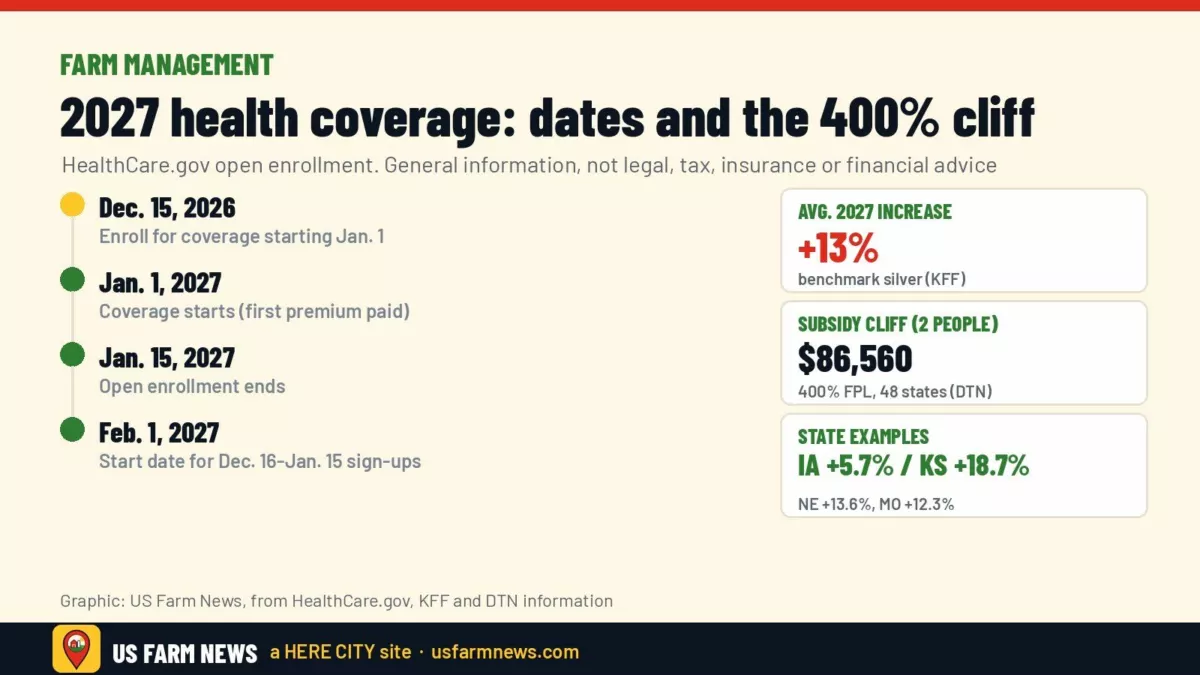
- Farm families buying their own coverage through HealthCare.gov need to sign up by Dec. 15 for coverage that starts Jan. 1. Open enrollment ends Jan. 15, 2027.
- Benchmark ACA premiums are rising about 13% on average for 2027, after a 26% jump for 2026, according to KFF. The increase is 5.7% in Iowa and 18.7% in Kansas.
- Premium tax credits stop completely above 400% of the federal poverty level. That’s $86,560 for a two-person household for 2027 coverage, DTN reported, so estimating farm income carefully matters.
- Self-employed farmers with a Schedule F profit may be able to deduct premiums on Form 7206, but not for months they could have joined an employer plan, including a spouse’s.
Health insurance costs have become one of the biggest worries for farm families this fall. At the Minnesota Farmers Union convention, president Gary Wertish told Brownfield that members brought up the high cost of health care again and again, along with input and fuel costs. With the first HealthCare.gov deadline 17 days away, here’s how farm households that buy their own coverage can work through 2027 enrollment.
This is general information, not legal, tax, insurance or financial advice. Check your situation with a licensed navigator or agent and your tax preparer.
Key dates
- Dec. 15, 2026: last day to enroll in or change a HealthCare.gov plan for coverage starting Jan. 1. You also have to pay the first premium.
- Jan. 15, 2027: open enrollment ends. Sign up between Dec. 16 and Jan. 15 and coverage starts Feb. 1.
- After Jan. 15: signing up requires a Special Enrollment Period, which is triggered by life events such as losing other coverage, moving, marrying or having a baby.
If your state runs its own exchange instead of HealthCare.gov, confirm its deadlines there.
Why 2027 is harder on farm budgets
KFF found that finalized benchmark silver premiums are up an average of 13% for 2027. Insurers blamed rising medical costs and a sicker, smaller risk pool now that the extra pandemic-era premium help has lapsed (it ended with 2025). Costs vary widely by state. DTN, citing KFF figures, reported average increases of 5.7% in Iowa, 12.3% in Missouri, 13.6% in Nebraska and 18.7% in Kansas.
By KFF’s estimate, roughly 27% of people who farm, ranch or manage agricultural operations get their insurance through the ACA, DTN noted, though KFF’s figure dates to 2023. CMS said rural enrollment in ACA plans fell 10% for 2026, compared with 4% in urban areas, according to DTN. KFF also expects fewer insurers in 2027: as of Oct. 29, 11 carriers had announced plans to leave at least one state and seven planned to enter a new one.
The 400% cliff and farm income
Marketplace savings are based on what you expect your household’s modified adjusted gross income (MAGI) to be in the coverage year, not on last year’s return, HealthCare.gov says. Anyone above 400% of the federal poverty level now gets no premium tax credit at all, and DTN notes the cutoff is abrupt: earning $1 over the line can mean losing the whole subsidy. DTN put the line at $86,560 for a two-person household for 2027 plans in the 48 contiguous states. One Iowa farm couple told DTN that losing the subsidy would cost them about $23,000 a year.
For farm families, that makes the income estimate the most important line on the application:
- Report net farm profit, not gross sales. HealthCare.gov says self-employed applicants report income after business expenses, and a loss is reported as a loss. List farm income as either farming or self-employment income, not both.
- Base it on a realistic 2027 budget. HealthCare.gov asks for your best estimate based on past results and realistic expectations. Think about when you plan to sell grain or cattle, government payments and off-farm wages.
- Update it during the year. If income comes in higher than you estimated, you may have to repay some or all of the advance credit when you file taxes. If it comes in lower, you may be owed more. Report changes to the Marketplace promptly.
- Know which moves lower MAGI. KFF says contributions to a traditional IRA, or to a health savings account if you’re in an HSA-eligible plan, can reduce MAGI and may raise your credit. Year-end sales timing and other tax moves should go through your tax preparer. See our 2026 tax planning guide for more.
Don’t miss the self-employed health insurance deduction
According to IRS instructions for Form 7206, a farmer with a net profit on Schedule F may be able to deduct premiums paid for medical, dental, vision and qualified long-term care insurance for themselves, a spouse and dependents. The deduction can also cover a child under 27 who isn’t a dependent. There are limits:
- You can’t take it for any month you or your spouse were eligible for an employer-subsidized health plan, even if you didn’t enroll.
- The deduction is capped by the net earnings of the business under which the plan is set up.
- Partners and more-than-2% S corporation shareholders have their own rules on whose name the policy is in and how premiums are reported.
Five steps before Dec. 15
- Pull your 2026 Schedule F estimate and draft a 2027 farm budget.
- Check where that income lands against 400% of the poverty level for your household size.
- Log in to HealthCare.gov and compare your current plan’s 2027 premium with other options. Don’t just let it auto-renew.
- Check whether your doctors and nearest hospital are in the plan’s network, especially if your insurer is leaving your state.
- Ask your tax preparer about the Form 7206 deduction and any moves that would lower MAGI.
More farm finance help is in our Farm Management section, including our year-end balance sheet guide.
Frequently asked questions
What is the deadline to get ACA coverage starting Jan. 1, 2027?
Dec. 15, 2026, on HealthCare.gov. Open enrollment runs through Jan. 15, 2027, and sign-ups after Dec. 15 start coverage Feb. 1.
What income do farmers report on a Marketplace application?
Expected net self-employment income for the coverage year, meaning revenue minus business expenses, as part of household MAGI. A net loss is reported as a loss.
Can farmers deduct health insurance premiums?
Often, yes. IRS Form 7206 lets self-employed people with a net profit deduct qualifying premiums, but not for months they were eligible for an employer-subsidized plan, including through a spouse.
Get the Daily Ag Business Briefing
Markets, policy and farm business in one free email each weekday.