A HERE CITY site

UGA’s AI Spot Sprayer With 156 Nozzles Cut Onion Herbicide Use 60%; LiDAR Saved 60% on Pecan Fungicide: What Growers Can Use Now
A UGA AI sprayer with 156 half-inch-spaced nozzles cut onion herbicide 60%, and LiDAR spraying saved 60% on pecan fungicide. What the data mean for growers.
Key takeaways
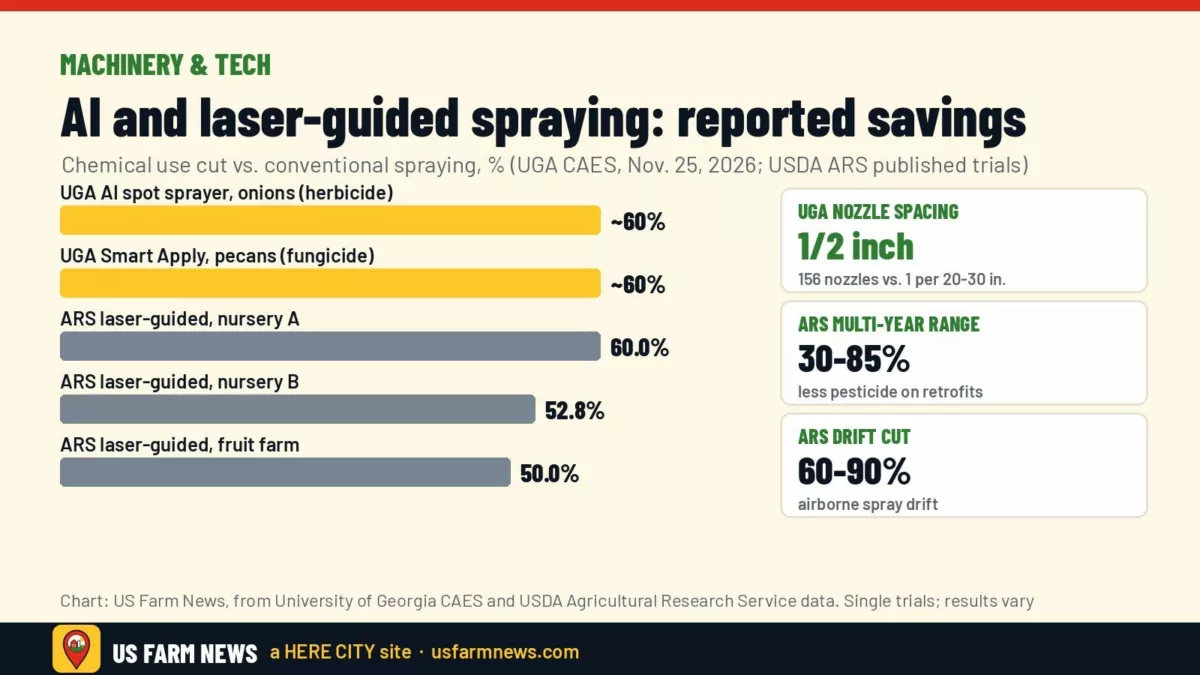
- A University of Georgia sprayer with 156 independent nozzles set a half-inch apart used 60% less herbicide in an onion test than a standard broadcast sprayer. Crop injury also dropped significantly, UGA said on Nov. 25.
- The same Tifton team says a LiDAR-guided Smart Apply system cut pecan fungicide use by about 60% in a trial last year.
- That fits years of USDA Agricultural Research Service testing of the laser-guided system, which found pesticide cuts of 30% to 85% on retrofitted airblast sprayers.
- The onion machine is still a research prototype. Growers can buy the canopy-sensing retrofit approach now.
Vegetable growers spend money spraying bare ground between weeds. A University of Georgia team says AI can cut most of that waste. UGA’s agriculture college (CAES) reported on Nov. 25 that a weed sprayer built by its Precision Horticulture Team in Tifton reduced herbicide use 60% in an onion test compared with standard broadcast spraying. It also caused significantly less damage to the onions.
The machine packs 156 nozzles into the bed width, about half an inch between each one. A conventional sprayer, by UGA’s comparison, puts a nozzle every 20 to 30 inches. Every nozzle is controlled separately. Cameras running AI-based machine vision spot a weed, and only the nozzle above it fires.
“Each of the 156 nozzles opens and closes independently,” Luan Oliveira, an agricultural engineer and assistant professor who heads the Tifton group, said in the UGA report.
Why the nozzle spacing matters
Most commercial spot sprayers work at a coarser scale, where a single nozzle can cover 12 inches of row or more, Global Agriculture reported on Nov. 28. The UGA design narrows the target to about the width of one onion plant. That’s how it can hit a weed while missing the crop right next to it.
For high-value vegetables, less crop injury could matter as much as the chemical savings.
UGA hasn’t released the plot size or named the camera and software used, Global Agriculture noted. Treat the 60% figure as one test on one crop, not a guaranteed savings rate.
The orchard version is already commercial
Oliveira’s team also tested Smart Apply, which uses LiDAR (laser scanning that builds a 3D map) and real-time software to spray only pecan tree canopies and skip the gaps between trees. “We finished a trial last year using that tool, and the savings on fungicide chemicals were around 60%,” Oliveira said.
Independent federal research backs up the canopy-sensing idea. USDA’s Agricultural Research Service in Wooster, Ohio, developed and commercialized a laser-guided, variable-rate spray control system that bolts onto existing airblast sprayers; a later ARS paper on it was co-written with Smart Apply staff. In ARS’s published results, the system:
- cut pesticide use by an average of 60.0% and 52.8% at two ornamental nurseries and 50.0% at a fruit farm in Ohio over two seasons, with pest and disease control equal to or better than conventional spraying
- saved up to $809 per acre in pesticide costs per season in that study
- reduced pesticide use by 30% to 85%, airborne drift by 60% to 90% and spray lost to the ground by 40% to 80% across multi-year development and on-farm tests
ARS says apple, citrus, grape, pecan and nursery growers in the U.S. and other countries have either added the system to their sprayers or bought new sprayers with it built in.
What growers can take from this now
- Start where spray is mostly wasted. Savings are biggest when weeds are patchy or tree canopies have gaps, such as young orchards, missing trees or widely spaced rows. Solid canopies and heavy weed pressure leave less to save.
- Run your own numbers. Multiply your yearly chemical bill per acre by a cautious savings rate, well below the 60% headline, and compare that with the kit price and any subscription. ARS reported savings anywhere from $140 to $2,400 per hectare a year, depending on the crop and location.
- Insist on control data, not just savings. The ARS work tracked pest and disease levels alongside chemical use. Ask any vendor for trials that show both.
- Check the label. Make sure variable-rate or spot application still meets label rates for the area actually sprayed.
- Watch the research pipeline. UGA’s onion sprayer is a test machine. UGA Grand Farm near Perry, Ga., holds field days where growers can see new spray and robotics tools working.
For row-crop spot spraying, see our smart sprayer cost comparison, and for orchards, our look at camera steering for orchards and vineyards. More is in Machinery & Tech.
What to watch
- Whether UGA publishes full plot data for the onion trial, or a company licenses the half-inch nozzle design.
- More UGA seed-grant projects using AI in poultry, livestock and crop breeding.
- Price and availability of canopy-sensing retrofit kits ahead of the 2027 spray season.
Frequently asked questions
How much herbicide did UGA’s AI sprayer save?
UGA reported a 60% cut in herbicide use in an onion test compared with standard broadcast spraying, along with significantly less crop injury.
Can farmers buy the UGA onion sprayer?
Not that UGA has announced. It’s a research machine. Smart Apply, the LiDAR system the team also tested, is a commercial product, and USDA ARS says laser-guided retrofits of this kind are already used by apple, citrus, grape, pecan and nursery growers.
How much do laser-guided orchard sprayers save?
USDA ARS tests found pesticide use fell 30% to 85% with pest control comparable to conventional spraying. Savings ran $140 to $2,400 per hectare a year depending on the crop and location.
Get the Daily Ag Business Briefing
Markets, policy and farm business in one free email each weekday.