A HERE CITY site

Mosaic Idles Florida Phosphate Mine Over Sulfur Costs, Says Cuts Will Run Through at Least Q1 2027 as MAP Tops $1,000
Mosaic idles its South Fort Meade phosphate mine Dec. 8 over sulfur costs and expects cuts through Q1 2027, with retail MAP at $1,004 a ton and DAP at $948.
Key takeaways
- Mosaic is idling its South Fort Meade phosphate mine in Central Florida. About 199 workers are set to be laid off on Dec. 8, and the company expects the shutdown to last more than six months.
- A Mosaic spokeswoman told Brownfield that the company’s production cuts should last at least through the first quarter of 2027. That points to tight phosphate supply going into spring.
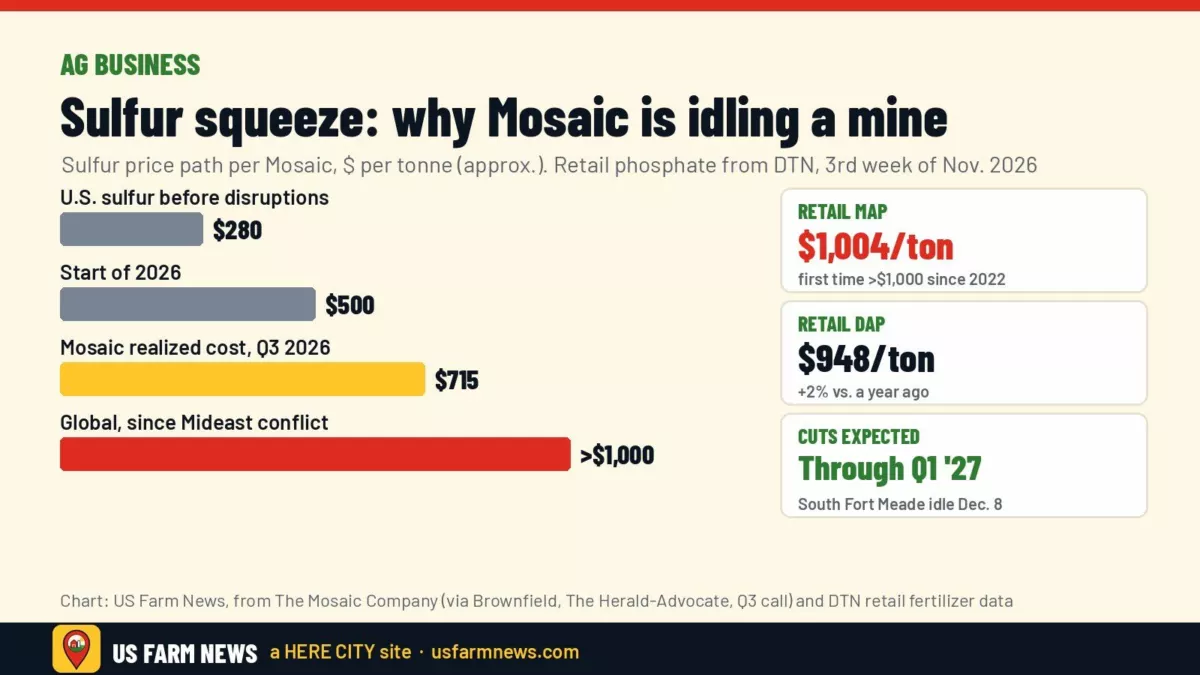
- Retail phosphate is already expensive. DTN’s third-week-of-November survey had DAP at $948 a ton and MAP at $1,004, MAP’s first time over $1,000 since 2022.
- The root problem is sulfur. Mosaic says it needs roughly 4 million tons of sulfur to produce 10 million tons of phosphate fertilizer.
Phosphate giant Mosaic is cutting back again, and farmers planning spring phosphorus should take note. The company told Brownfield on Nov. 27 that its production cuts, caused by expensive and hard-to-find sulfur, are expected to continue at least through the first quarter of 2027. That means tighter phosphate fertilizer supplies and probably little relief on price, the company said.
The newest cut hits Central Florida. Jackie Barron, a senior public affairs manager at Mosaic, told Brownfield that workers at one of the company’s Florida mines will be out of work in a couple of weeks. She said the idling affected almost 200 jobs and came after about 300 job cuts tied to the company’s Louisiana idling. “This was the last lever we would want to pull,” Barron said.
What’s closing and for how long
The mine is South Fort Meade, on the Polk-Hardee county line. Mosaic’s federal WARN notice to Florida lists 199 layoffs with Dec. 8 as the separation date, FOX 13 Tampa Bay reported. According to the filing, Mosaic expects the pause to last more than six months and hasn’t set a restart date. A small crew will stay on site for maintenance, safety and environmental compliance.
On its Nov. 3 earnings call, Mosaic said it had idled mining at South Fort Meade and at Miski Mayo in Peru to keep from piling up phosphate rock while its processing plants run below capacity. It has also curtailed production at Bartow, Fla., in Louisiana and in Brazil. CEO Bruce Bodine said in the third-quarter release that the company had lined up phosphate output with “the availability of affordable sulfur.”
Why sulfur sets the pace
Phosphate plants burn sulfur to make sulfuric acid, which they use to break down phosphate rock. By Barron’s math, Mosaic uses roughly 4 million tons of sulfur to turn out 10 million tons of phosphate fertilizer. She said Russia’s war on Ukraine and the shutdown of shipping through Hormuz are why sulfur remains so costly.
The cost has climbed fast. Mosaic told The Herald-Advocate that U.S. sulfur ran about $280 per tonne before the latest disruptions, about $500 at the start of 2026, and more than $1,000 globally after the Middle East conflict began. On the earnings call, Mosaic said its realized sulfur cost was $715 a ton in the third quarter and that it expected $800 to $850 in the fourth. That’s because higher-priced inventory is still working through its system, even though Mosaic settled its fourth-quarter sulfur contract lower, at $615 a long ton.
Bodine also said on the call that Mosaic has sulfur lined up for 2027 to cover about 65% to 66% of its production needs. The contracted volume still isn’t enough to run its U.S. plants fully, and spot sulfur isn’t cheap enough yet to restart idled production, executives said.
What it means for your 2027 phosphorus bill
DTN’s retail survey for the third week of November found five of eight major fertilizers slightly higher than a month earlier:
- DAP: $948 a ton, up 2% from a year earlier
- MAP: $1,004 a ton, up 8% from a year earlier
- 10-34-0: $706 a ton, up 6%
- Potash: $508 a ton, up 4%
DTN said every fertilizer it tracks now costs more than a year ago. Mosaic, for its part, doesn’t set retail prices. “We sell to wholesalers,” Barron said. She added that the company’s outlook for 2027 “still remains fairly cloudy.”
Mosaic says farmers can’t keep skipping phosphorus forever. Bodine said on the call that North American growers have probably used up most of the leftover nutrients in their soils.
Ways to manage phosphate cost and supply risk
- Start with a current soil test. If phosphorus tests at or above the agronomic optimum, you may be able to trim rates for a year. If it tests low, cutting is riskier.
- Price it per pound of P2O5. Compare MAP, DAP and liquid 10-34-0 on cost per pound of nutrient delivered and applied, not on cost per ton.
- Ask your retailer about supply now. With Mosaic’s cuts expected into the first quarter of 2027, ask what tons your dealer has booked for spring and whether a prepay or booking locks in delivery as well as price.
- Put the bigger P bill in your budget. Build 2027 crop budgets with today’s retail prices, not last year’s.
We covered the policy side of the sulfur squeeze in lawmakers’ call for Defense Production Act action on sulfur and phosphate and looked at earlier price moves in our November fertilizer price report. More input coverage is in our Ag Business section.
What to watch
- Dec. 8, when the South Fort Meade layoffs take effect.
- Mosaic’s first-quarter 2027 sulfur contract, and whether spot sulfur falls far enough to restart idled plants.
- DTN’s weekly retail prices, especially whether MAP stays above $1,000.
- Shipping through the Strait of Hormuz, the biggest swing factor for global sulfur.
Frequently asked questions
Why is Mosaic idling a phosphate mine?
Mosaic says sulfur, which it needs to process phosphate rock, is too scarce and too expensive. It has cut how much rock it processes, so it’s idling mining to avoid stockpiling rock.
How long will Mosaic’s production cuts last?
A Mosaic spokeswoman told Brownfield that cuts are expected to run at least through the first quarter of 2027. The company expects the South Fort Meade idle to last more than six months.
What are retail DAP and MAP prices now?
DTN’s survey for the third week of November 2026 averaged $948 a ton for DAP and $1,004 for MAP.
Get the Daily Ag Business Briefing
Markets, policy and farm business in one free email each weekday.