A HERE CITY site

Planted All Corn on Corn-and-Soy Base? How ARC-IC Can Beat ARC-CO Before the Dec. 11 Deadline
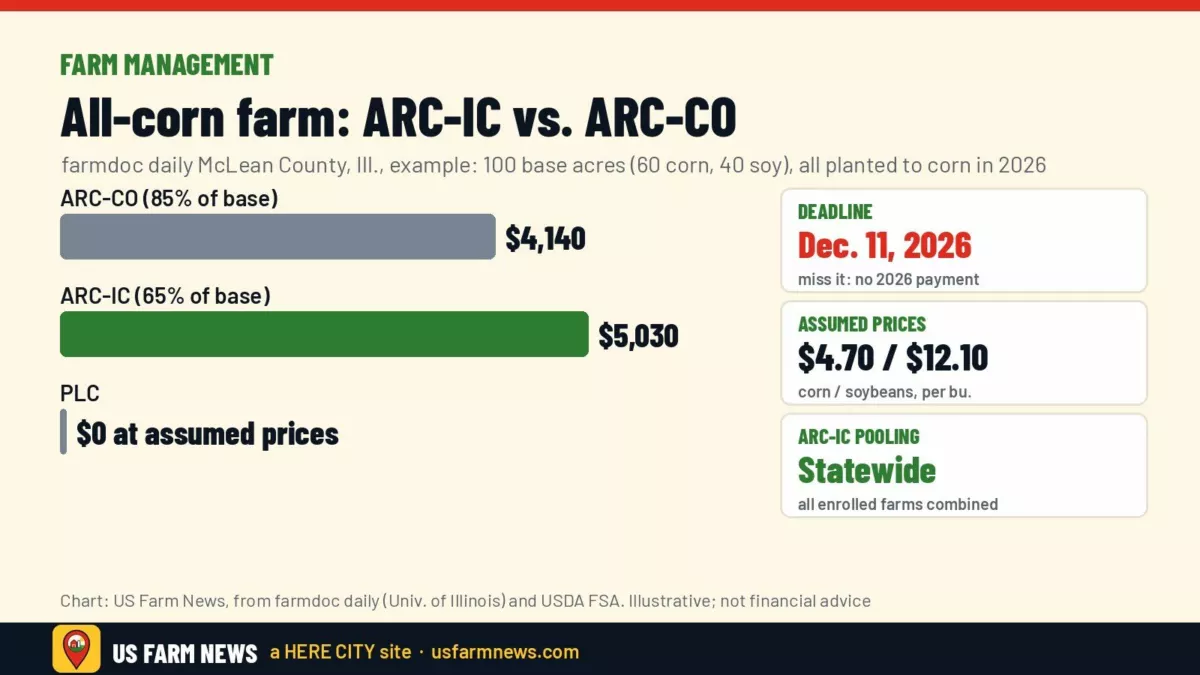
A farmdoc example shows ARC-IC paying $5,030 vs. $4,140 under ARC-CO on an all-corn farm. How to run your own numbers before the Dec. 11 ARC/PLC deadline.
Key takeaways
- FSA farms planted entirely to corn in 2026 with below-par yields should run the numbers on ARC-Individual (ARC-IC) before the Dec. 11 ARC/PLC deadline, University of Illinois farmdoc economists say.
- In their McLean County, Ill., example, ARC-IC pays about $5,030 on a 100-base-acre farm versus $4,140 under ARC-County, because soybean base acres earn nothing under ARC-CO.
- ARC-IC payments cover just 65% of base acres (vs. 85%), pools every farm you enroll in the state, and requires certified yields, so it isn’t a fit for most farms.
- Miss the deadline and FSA keeps your 2025 election, but the farm gets no 2026 payment.
With harvest nearly wrapped up and the 2026 ARC/PLC sign-up deadline two weeks away, many Corn Belt growers already know their yields. That makes this an unusual year to take a hard look at Agriculture Risk Coverage at the individual level, or ARC-IC, a whole-farm option that most producers skip. A new farmdoc daily analysis from the University of Illinois points to one situation where it can pay more: an FSA farm that was planted all to corn and yielded poorly, but carries both corn and soybean base acres.
This is general information, not legal, tax, or financial advice. Confirm your farm’s numbers with your FSA office and advisers.
The deadline and the three choices
For each FSA farm, producers choose ARC-County (ARC-CO) or Price Loss Coverage (PLC), which work crop by crop, or ARC-IC, which covers the whole farm, according to USDA’s Farm Service Agency. Elections are due Dec. 11, 2026. If you don’t submit one, FSA says your 2025 election carries over and the farm is ineligible for 2026 payments. Producers can also sign a new multi-year contract running from 2026 through 2031. Any 2026 payments wouldn’t arrive until October 2027, farmdoc noted.
Why an all-corn farm can come out ahead
ARC-CO and PLC pay on a farm’s historical base acres, no matter what was planted. ARC-IC instead measures revenue on the crops actually planted in 2026 against the farm’s own history. So if a farm with corn and soybean base planted only corn, and corn revenue fell short while soybeans would not have triggered, ARC-IC can shift the whole payment onto the corn loss, farmdoc economist Hongxia Jiao explained.
The farmdoc example uses a McLean County, Illinois, farm with 100 base acres, split 60 corn and 40 soybeans, and all 100 acres planted to corn in 2026. Key assumptions:
- Prices: season-average prices of $4.70 a bushel (corn) and $12.10 (soybeans). At those prices PLC wouldn’t pay on either crop.
- County yields: 210 bushels of corn (versus a 235.9-bushel benchmark) and 70 bushels of soybeans (versus 73.3).
- ARC-CO result: about $69 per corn base acre and nothing on soybean base, or $4,140 for the farm.
- ARC-IC result: a farm corn yield of 210 bushels gives revenue of $987 an acre, below a guarantee of $1,064.39 (90% of the farm’s $1,182.66 benchmark). After the 65% factor, that’s $50.30 per base acre on all 100 base acres, or $5,030.
That’s $890 more under ARC-IC in this case. The authors stress the result depends on these exact yields, prices and acres and won’t hold everywhere.
How to run your own comparison
- Gather records. Pull your 2026 planted and prevented-planting acres, harvested yields by FSA farm, and farm yields for 2020 through 2024. ARC-IC uses yields certified to FSA, which can be supported by crop insurance production records, farmdoc said.
- Know the benchmark rules. In a benchmark year with a very low yield, 80% of the county transitional yield is substituted. In years the crop wasn’t planted, the county yield is used. The highest and lowest years are dropped from the five-year average.
- Use a calculator. The ARC-IC calculator built into farmdoc’s Farm Bill What-If Tool can do the math. Enter your county, crops, historical yields, 2026 acres and yields, and a range of price assumptions. The November WASDE projected season-average prices of $4.60 for corn and $12.10 for soybeans, farmdoc noted, but final prices won’t be known until fall 2027.
- Compare totals, not per-crop figures. Because ARC-IC covers every covered commodity on the farm, line it up against the combined ARC-CO or PLC payments for every crop on the same FSA farm.
- Test combinations. All farms you enroll in ARC-IC in the same state are pooled into one. A strong farm can wipe out a weak farm’s payment. farmdoc suggests ranking farms by estimated ARC-IC payment per base acre, then adding them one at a time and keeping each only if the total rises.
- Visit FSA early. Confirm yield certification requirements and sign before Dec. 11.
When ARC-IC usually doesn’t fit
- Fewer payment acres. ARC-IC’s payment factor is 65% of base acres; ARC-CO and PLC use 85%. With equal percentage losses, farmdoc estimates a farm’s benchmark would need to be about 30% above the county’s for ARC-IC to match ARC-CO.
- Mostly corn base. The bigger a farm’s share of corn base, the higher its ARC-CO payment and the smaller the ARC-IC edge.
- County hit harder than you. If county yields fell more than yours, ARC-CO gains ground.
- Higher prices. A rally in the season-average price shrinks or erases revenue shortfalls under either program.
- Paperwork and timing. ARC-IC requires certified yields, and its payments have historically taken longer to process.
ARC-IC also has a cap: under the 2025 changes it guarantees 90% of benchmark revenue and pays at most 12% of benchmark. Farms that were completely prevented from planting can hit that maximum, and localized losses from hail, flooding or drought are other cases worth a look, farmdoc’s Nov. 10 article said. Historically, the option is a niche one, used on about 6% of corn and soybean base in 2019 and about 1% in 2021 and 2022.
For the broader choice between county coverage and price protection, see our earlier guide to ARC-CO vs. PLC for 2026, and why Illinois corn yields came in 17 bushels below trend.
Frequently asked questions
What is the 2026 ARC/PLC deadline?
Dec. 11, 2026. Without a new election, FSA keeps your 2025 choice and the farm is ineligible for 2026 payments.
Who should consider ARC-IC?
Farms planted entirely to one crop with weak yields, farms that were fully prevented from planting, and farms with localized losses that the county average doesn’t reflect, according to farmdoc.
Does ARC-IC combine my farms?
Yes. All FSA farms you enroll in ARC-IC within a state are pooled, so test combinations before you sign.
Get the Daily Ag Business Briefing
Markets, policy and farm business in one free email each weekday.