A HERE CITY site

Farm AI Moves From Maps to Recommendations: What Bayer, Deere and PTx Pitched for 2027, and 5 Questions to Ask First
Ag tech firms pitched AI reports, weed maps and autonomy at NAFB Trade Talk as Nebraska rural AI use hits 55%. Five checks before you trust the advice.
Key takeaways
- At the recent NAFB Trade Talk, ag tech companies pitched AI that turns field data into ready-made reports and recommendations, including “instant insights” in Bayer’s Climate FieldView and Deere’s See & Scout weed maps.
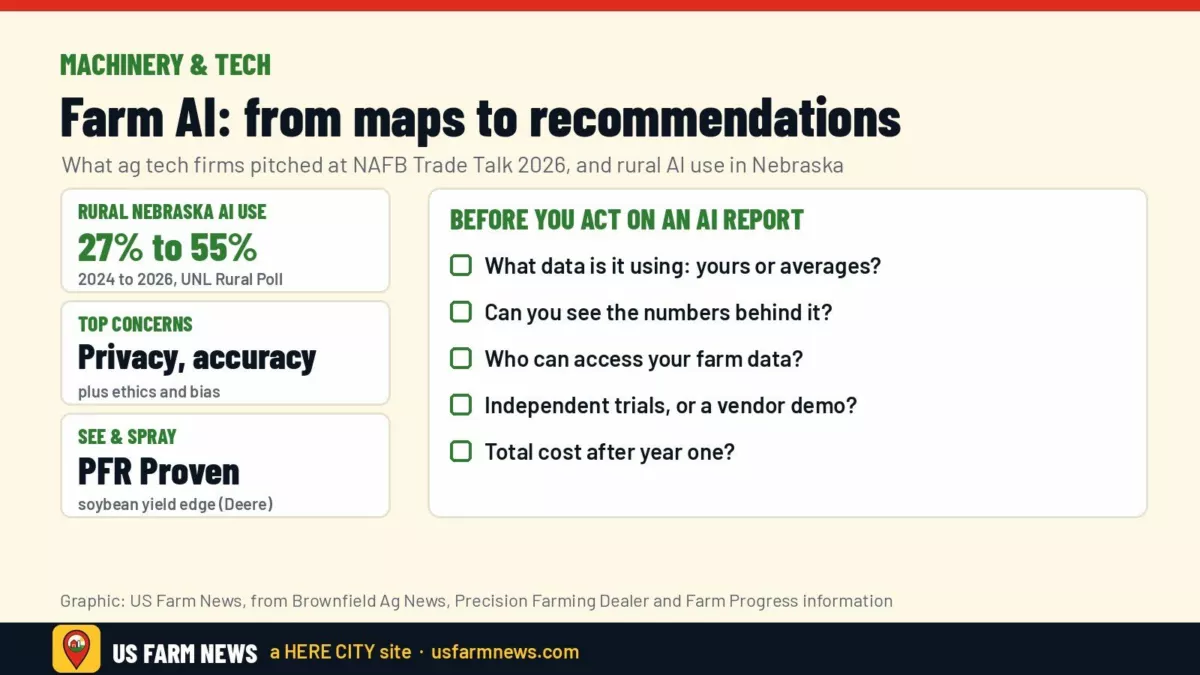
- Deere said See & Spray earned Beck’s PFR Proven status for a soybean yield advantage; corn research is underway.
- A University of Nebraska-Lincoln Rural Poll found AI use among rural Nebraskans jumped from 27% in 2024 to 55% in 2026, with privacy and accuracy topping users’ concerns.
- Before relying on an AI recommendation, ask what data it uses, who can see your data, and how you can check its work.
Farm software is moving past colorful yield maps toward tools that tell growers what the data means and what to do next. That was the message from several precision ag companies at the 2026 National Association of Farm Broadcasting (NAFB) Trade Talk in Kansas City, and it lands as more rural Americans try artificial intelligence for the first time.
For a farm business, the promise is fewer hours spent digging through screens and faster decisions on seed, spray and field order. The risk is trusting a recommendation you can’t verify. Here’s what was announced, and how to put it to work without losing control of your data.
From “data rich” to decisions
Bayer Crop Science digital ag specialist Andy Folta told Brownfield the company keeps adding AI tools to its Climate FieldView platform with the goal of giving farmers more data-driven recommendations. He said growers should stop being “data rich and insight poor.” FieldView is moving toward instant, automatically generated reports, he said, such as how a farm performed by soil type and seeding population and whether it is trending the right way from year to year.
Weed maps on every pass
John Deere’s Alex Shock, product marketing lead for precision upgrades, told Precision Farming Dealer that See & Spray drew the most interest of Deere’s precision tools with growers and dealers this year. He said Beck’s Practical Farm Research has designated See & Spray “PFR Proven” for a yield advantage in soybeans, with corn trials underway.
The newer piece is See & Scout, launched this year, which builds weed pressure maps during passes when the sprayer isn’t applying herbicide. Shock said growers had asked for that because maps had only been available from See & Spray passes, leaving early residual trips without that information. The maps can help a farmer decide which fields to hit first on post-emerge passes. Deere also added wheat and barley crop models this year and a front camera kit as a precision upgrade, he said.
Autonomy and camera spraying
PTx marketing manager Bryce Baker said the OutRun autonomy retrofit kit is being used on Fendt and John Deere tractors for tillage and harvest work, with the best results so far on larger operations doing intensive field work, such as multi-crop farms in California and big Great Plains harvest crews, according to Precision Farming Dealer. Many farmers are still testing and demoing, he said. Baker also pointed to SymphonyVision, a camera-guided spraying system that adjusts applications on the go based on the size, density and type of weeds it detects, as a 2027 product to watch.
Not every upgrade means a new machine. Case IH regional precision ag manager Josh Moore described aftermarket kits, such as the Pro 1200 Guidance Kit, as a lower-cost way to bring a current display and guidance into an older cab.
Rural users are adopting AI, cautiously
Outside the cab, AI use is climbing fast. The Nebraska Rural Poll, run by Nebraska Extension and Rural Prosperity Nebraska, found 27% of respondents had used an AI tool in 2024, rising to 55% in 2026, Farm Progress reported. The poll was mailed in April to households outside Omaha and Lincoln. Health information, science and technology, and education were among the most common uses.
Respondents were wary, too. Privacy, ethics, accuracy and bias ranked among their top concerns, outranking interest in learning to get more out of the tools, according to Farm Progress. UNL associate professor Bryan Wang said most people wanted to know how to protect their privacy and judge whether AI answers are accurate.
5 questions to ask before you act on an AI recommendation
- What data is it using? Your own yield, soil and as-applied layers, or regional averages? A recommendation built on someone else’s fields may not fit yours.
- Can you see the reasoning? A good report shows the numbers behind it, such as which zones underperformed and by how much, so you or your agronomist can check it.
- Who owns and can access your data? Read the data-use terms, including whether data is shared with seed, chemical or lending partners.
- Is the claim backed by independent trials? Third-party results, like Beck’s PFR program, carry more weight than a vendor demo. Ask what crops and conditions were tested.
- What does it cost after year one? Ask about subscriptions, per-acre fees and hardware you may need to add.
Start small: test one AI-generated recommendation on a few fields with a check strip, and compare results at harvest before rolling it out. For more on vetting these tools, see our checklist on questions to ask before trusting an AI marketing assistant and our breakdown of smart sprayer costs and break-even.
Get the Daily Ag Business Briefing
Markets, policy and farm business in one free email each weekday.