A HERE CITY site

Army Sets Iowa Lead Azide Blast for 9 a.m. Wednesday as USDA Says About 350 Farms Could Be in the Plume’s Path
The Army will detonate degraded lead azide near Middletown, Iowa, at 9 a.m. CT Wednesday. USDA says about 350 farms could be affected; here's what to do.
Key takeaways
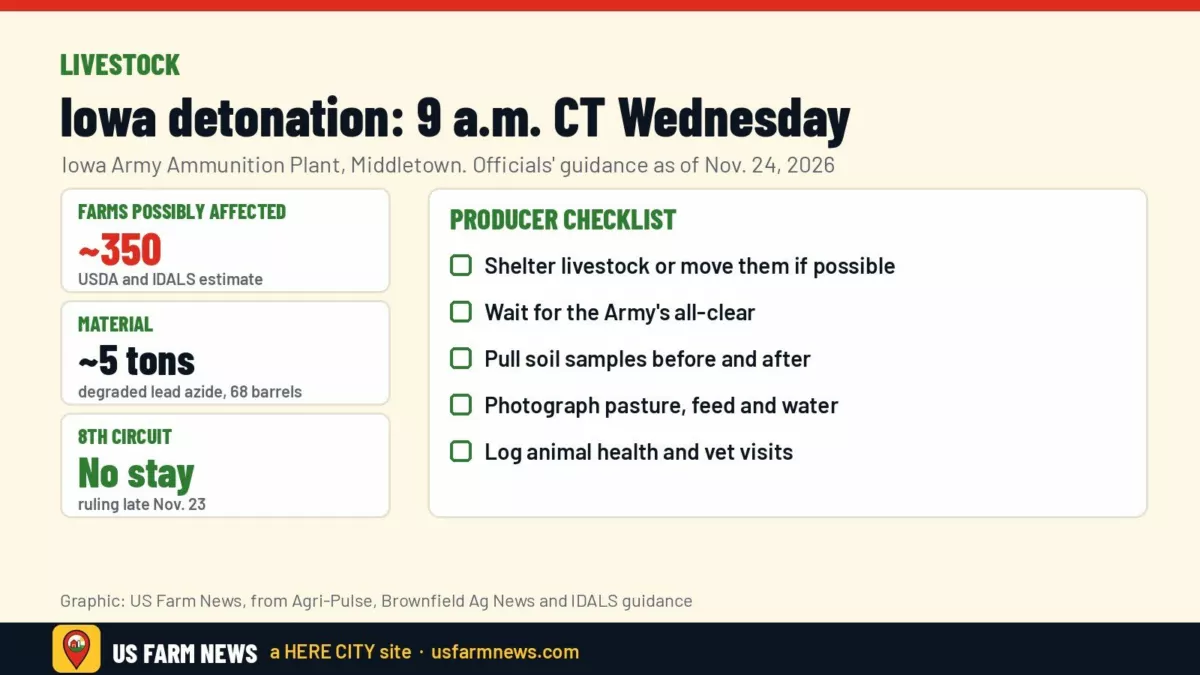
- The Army confirmed it will detonate degraded lead azide at the Iowa Army Ammunition Plant near Middletown at 9 a.m. CT Wednesday, Nov. 25, after the 8th Circuit declined to block the EPA permit.
- USDA and Iowa’s agriculture department estimate about 350 farms could be affected, based on the expected plume direction for a Wednesday blast.
- Officials advise moving livestock indoors or to another site until the Army says the area is clear, and taking soil samples before and after; EPA says its teams are also sampling.
- Farm groups say most cow-calf herds in the area have no way to house cattle on short notice.
The controlled blast that southeast Iowa farmers have been bracing for since mid-November is scheduled for Wednesday morning. The Army has set the detonation of roughly five tons of deteriorated lead azide at the Iowa Army Ammunition Plant for 9 a.m. Central time, Brownfield reported, after a federal appeals court late Monday refused to put the operation on hold.
For livestock and specialty crop producers downwind, the practical questions are the same ones raised a week ago: where to put animals for a few hours, how to document soil and forage conditions, and how to prove any damage later. Federal officials said Tuesday they have a sampling plan in place, but farm groups say the timeline has left little room to prepare.
Court clears the way
Environmental groups had won a temporary administrative stay of the emergency permit EPA issued to the Army. On Monday, Nov. 23, the St. Louis-based 8th Circuit refused a longer emergency stay, saying EPA had built in safeguards to limit how much lead dust escapes and to reduce exposure risks, Agri-Pulse reported. The three-judge panel also noted the explosive has degraded to the point that it is highly sensitive to friction and can’t be moved, and that falling temperatures add to the danger of an uncontrolled chain reaction among the 68 barrels.
President Trump had said earlier Monday that the military should hold off until the appeals court weighed in. An attorney for the environmental groups said they respect the ruling but argued the Army still owes Iowans more information and protection, according to Agri-Pulse.
How many farms, and what officials told them
At a Tuesday news conference, USDA farm production Under Secretary Richard Fordyce said his agency and the Iowa Department of Agriculture and Land Stewardship (IDALS) put the number of farms that could be affected at approximately 350, based on where the plume is expected to go. He called the projected plume “maybe the worst-case scenario,” Agri-Pulse reported. USDA is coordinating with Iowa Agriculture Secretary Mike Naig and Missouri Agriculture Director Chris Chinn, he said.
The IDALS guidance Fordyce pointed to boils down to a few steps for producers near Middletown:
- Before the blast: move livestock to another location or into a barn, machine shed or other shelter if you can. If animals are already inside, close windows and doors only if that won’t put the animals at risk. IDALS acknowledges this won’t be possible for every herd.
- During and after: leave animals in shelter or at the other site until the Army announces it is safe and the dust cloud has moved through. The Army has said dust could take several hours to settle.
- Soil: landowners are being encouraged to pull soil samples before and after the detonation.
EPA’s Tom Croci said sampling teams were already in the field ahead of the blast, will run air monitors during it, and will sample afterward across the affected area. “No one should feel like they will not get a sample,” he said, according to Agri-Pulse.
The mitigation plan
Army explosive ordnance disposal Col. Aaron Teller described the safeguards: foam blanketing the site, a double row of water tanks holding 16,000 gallons apiece, and dirt-filled barriers rising higher than the storage magazines. He said the goal is zero release of lead particulate. Teller pointed to a 1977 Colorado disposal of about 7,000 pounds, done with no mitigation, in which he said three-quarters of the lead stayed on site. The Army’s maps show a potential plume running from southeast Iowa toward northeast Missouri, with the actual path depending on the weather; the National Weather Service is launching extra weather balloons.
Farmers: easier said than done
Henry County farmer Tim Meyer, who farms roughly 45 miles from the plant, told Brownfield that getting livestock indoors on short notice is a tall order, and that Des Moines County residents raised the same concern at local meetings. Earlier plume projections put his farm near the edge of the impact zone, he said, but the latest wind forecasts point the plume south and west instead.
Iowa Farmers Union Executive Director Matt Russell told Agri-Pulse that most cow-calf operations in the possible plume area lack buildings to house their cattle, and he described a “bipartisan frustration” with how the operation was planned. The Army held one public meeting in Middletown in October that drew about 200 people.
Iowa State University field agronomist Virgil Schmitt suggested bringing cattle in and shutting off ventilation fans where that is safe, while acknowledging that turning fans off in large swine barns is not an option. For animals on pasture, he would wait until a rain has washed residue into the soil before turning them back out. He told Agri-Pulse he doesn’t expect lead to hurt next year’s crop growth, because lead binds tightly to soil and plants take up little of it, but he still recommends before-and-after soil tests so farmers have proof if a problem appears.
What to do today
- Check the Army’s latest plume map and the all-clear notice before turning stock out.
- Photograph pastures, feed stores, water tanks and animals before and after, with time stamps.
- Keep soil sample receipts and lab results with your other farm records.
- Write down any animal health changes and vet visits in the days after.
Our earlier livestock checklist for baseline testing and claims covers record-keeping in more detail. For the rest of this week’s farm-business news, see the Daily Ag Business Briefing.
Frequently asked questions
When is the Iowa detonation?
The Army confirmed 9 a.m. Central time on Wednesday, Nov. 25, 2026, at the Iowa Army Ammunition Plant near Middletown.
How many farms could be affected?
USDA and IDALS estimate about 350 farms, based on the expected plume direction for a Wednesday blast. Fordyce described that projection as possibly the worst case.
Should I test my soil?
Officials and an Iowa State agronomist recommend before-and-after soil samples to document conditions. EPA says its own teams are also sampling across the affected area.
Get the Daily Ag Business Briefing
Markets, policy and farm business in one free email each weekday.