A HERE CITY site

U.S. Egg Output Jumps 8% in October as Laying Flock Nears 393 Million; Wholesale Eggs Bounce to $1.18
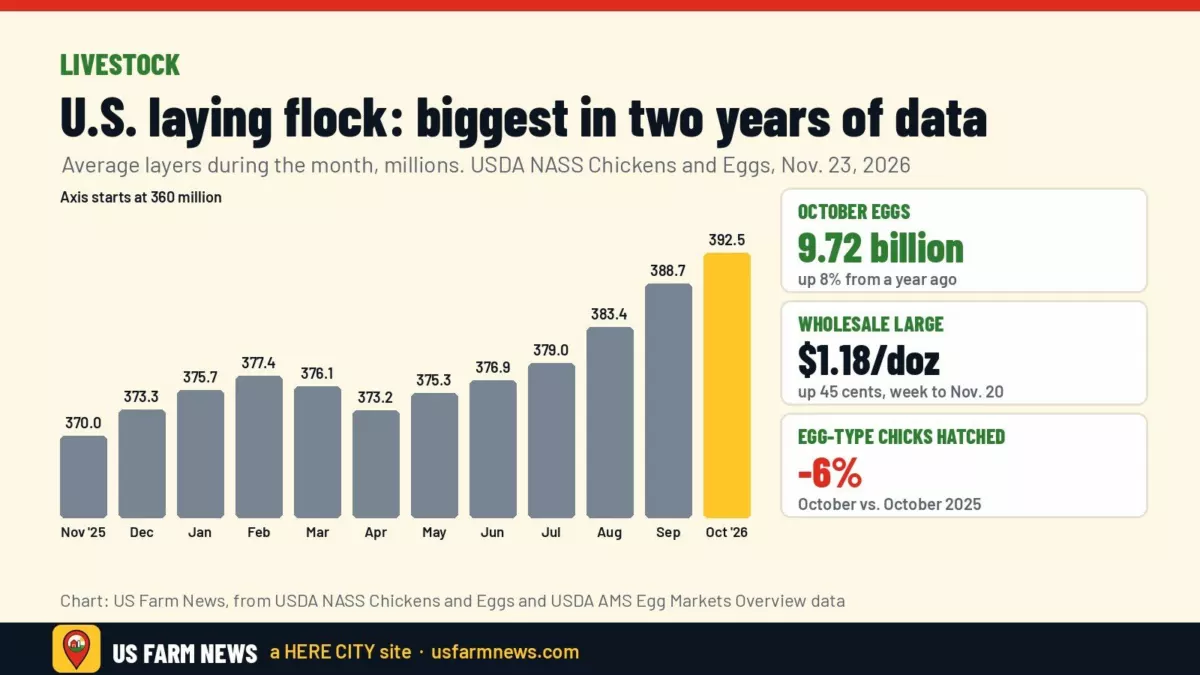
USDA says hens laid 9.72 billion eggs in October, up 8%, on a flock 6% larger. Wholesale Large eggs rose 45 cents to $1.18 a dozen on holiday demand.
Key takeaways
- U.S. hens laid 9.72 billion eggs in October, 8% more than a year earlier, USDA’s monthly Chickens and Eggs report said Monday.
- The October laying flock averaged about 392.5 million birds, up 6% from 2025, and output per 100 hens rose 1% to 2,478 eggs.
- Wholesale Large white eggs climbed 45 cents to $1.18 a dozen in the week to Nov. 20 as holiday baking lifted grocery features, USDA Market News said.
- Egg-type chicks hatched fell 6%, a hint that flock growth could slow. USDA’s next production forecasts come Dec. 10.
The U.S. laying flock is the biggest it has been in the two years of monthly data USDA published this week, and the eggs are showing up. Hens laid 9.72 billion eggs in October, an 8% gain on October 2025, the National Agricultural Statistics Service (NASS) said in its Chickens and Eggs report released Nov. 23. For egg producers, the bigger flock is a mixed blessing: more birds to sell from, but a market that only recently climbed back above a dollar a dozen at wholesale.
Why it matters for egg and feed businesses
More hens generally means more eggs chasing the same buyers, and the flock is now well above where it stood a year ago. A bigger flock also eats more corn and soybean meal, which matters to feed suppliers and grain sellers. For producers selling on formula prices tied to wholesale quotes, last week’s price bounce matters as much as the volume numbers, because it sets what lands on the check.
The numbers from USDA
- Total eggs, October 2026: 9.72 billion, up 8% from a year earlier (NASS).
- Table eggs: 8.42 billion. Hatching eggs: 1.31 billion, split between 1.20 billion for broiler flocks and 109 million for egg-laying flocks.
- Average layers in October: 392.5 million, up 6%. The flock has grown every month since April, when it averaged about 373.2 million, according to the NASS monthly table.
- Rate of lay: 2,478 eggs per 100 layers in October, up 1%.
- Layers on Nov. 1: 393 million, made up of 328 million table-egg hens, 60.6 million broiler breeder hens and 4.53 million egg-type breeder hens.
Brownfield noted that the flock and per-hen efficiency both moved higher, which together pushed output up faster than bird numbers alone.
Hatchery signals: fewer future layers in the pipeline
The forward-looking numbers were less bullish for supply growth. Egg-type chicks hatched in October totaled 53.6 million, down 6% from the same month last year, and egg-type eggs in incubators on Nov. 1 were 51.1 million, down 7%, NASS said. Brownfield said the drop was at least partly tied to flock management. Leading breeders did place 3% more egg-type pullet chicks to build future breeder flocks, about 243,000 birds.
On the broiler side, chicks hatched rose 1% to 864 million and eggs in incubators were also up 1%. Breeder companies added 8.14 million broiler-type pullets to their future supply flocks, 5% more than a year ago, which points to steady chicken meat output into 2027.
Prices: a holiday bounce from low levels
USDA’s Agricultural Marketing Service (AMS) said in its weekly Egg Markets Overview, dated Nov. 20, that negotiated wholesale prices rose all week on moderate to good retail interest. The national truck-lot price for graded, loose white Large eggs gained 45 cents to $1.18 a dozen. Other benchmarks AMS reported:
- Midwest Large white eggs delivered to warehouses: up 36 cents to $1.25 a dozen.
- Price paid to producers for Large cartoned eggs in the Midwest: up 36 cents to $1.07.
- New York Large cartoned eggs delivered to retailers: up 32 cents to $1.36.
- California Large shell egg benchmark: up 20 cents to $1.59.
Grocery features increased as stores promoted eggs for holiday baking. AMS put the average advertised price for conventional caged eggs at $1.44 a dozen, up 19 cents, while UEP-certified cage-free barn or aviary eggs averaged $2.58 in ads. Shell egg inventories at the start of the week were 6% lower, and stocks of Large eggs were down 13% nationally and 17% in the Midwest, the report said. Breaking stock, the eggs sold to processors, held at about 8.5 cents a dozen.
Context
The rebuild has come despite fresh bird flu losses this fall, including the large California layer outbreaks we reported earlier this month. Average layers in October 2026 were about 23 million birds above October 2025, the NASS table shows, which is why a one-week price jump has not changed the bigger picture of ample supply. Producers who rely on spot or formula pricing remain exposed to swings in both directions.
What to watch
- Nov. 25: NASS Broiler Hatchery and Poultry Slaughter reports.
- Nov. 30: NASS Egg Products report.
- Dec. 10: USDA updates its annual egg and broiler production projections with the December WASDE, Brownfield noted.
- Weekly AMS egg reports, to see whether the holiday price gain holds after the baking season.
For grain-side demand signals from the livestock sector, see our Livestock section.
Get the Daily Ag Business Briefing
Markets, policy and farm business in one free email each weekday.