A HERE CITY site

Lamb Import Relief Heads to a Dec. 1 ITC Hearing After 3-3 Vote: Tariffs, Quotas and What Sheep Producers Should Watch
The ITC holds a Dec. 1 remedy hearing on lamb imports after a 3-3 injury vote. Producers seek four years of tariffs; the President decides after Jan. 11.
Key takeaways
- The U.S. International Trade Commission holds a remedy hearing Dec. 1 in its Section 201 safeguard case on imported lamb meat.
- Commissioners split 3-3 on Nov. 13 over whether imports seriously injure U.S. producers. The three who voted yes singled out Australia.
- The commission’s report goes to the President by Jan. 11, 2027. Possible remedies include tariffs, quotas or both, and the President makes the final call.
- Producer groups are seeking a four-year tariff on imported lamb. Australia argues imports fill demand U.S. flocks can’t meet.
U.S. sheep producers get their next shot at import relief on Monday, Dec. 1, when the U.S. International Trade Commission (USITC) holds a public hearing on what remedy, if any, to recommend for the domestic lamb industry. The hearing follows a rare tie vote on Nov. 13 that kept the global safeguard case alive and sent it toward the White House.
For ranchers, lamb feeders and packers, the outcome could change the price ceiling imports put on domestic lamb. For importers and restaurants that rely on Australian and New Zealand product, it could mean higher costs.
How the tie vote works
The legal question was whether rising lamb imports are an important enough cause of serious harm, or the threat of it, to U.S. producers. Three commissioners said yes: Chairman Brett Doyle, Jason Kearns and Bart Thanhauser. Three said no: Samuel Negatu, David Foley Jr. and Peter-Anthony Pappas, the USITC said in its Nov. 13 release.
When the panel splits evenly in a safeguard case, the views of both sides go to the President, the commission said. That leaves the choice to the White House. Jennifer Hillman, a former commissioner now at Georgetown University, told ABC News in Australia that a tie lets the President pick which side’s vote counts as the winning one.
In findings tied to U.S. free trade agreements, the three commissioners who voted yes concluded that Australian lamb by itself is a major cause of the harm or threatened harm. They found that imports from Canada and Mexico are not a substantial share of the total, and that the other free trade partners named in the case are not, individually, a substantial cause.
What producers are asking for
R-CALF USA, working with the Protect American Lamb group, is asking commissioners to back a four-year tariff on imported lamb in fresh, chilled or frozen form, with rates that vary by cut instead of a per-pound charge, Brownfield reported. Mike Michener, executive director of the American Sheep Industry Association (ASI), told Brownfield that the recommendations could include tariffs, quotas or a mix. He said other options might include direct payments to producers.
Michener said low-priced Australian and New Zealand lamb has grown to almost 80% of the U.S. market. Former ASI president Brad Boner told Brownfield earlier this month that imports from the two countries supply about three-fourths of U.S. consumption, and that Australia’s exchange rate gives it roughly a 30% edge.
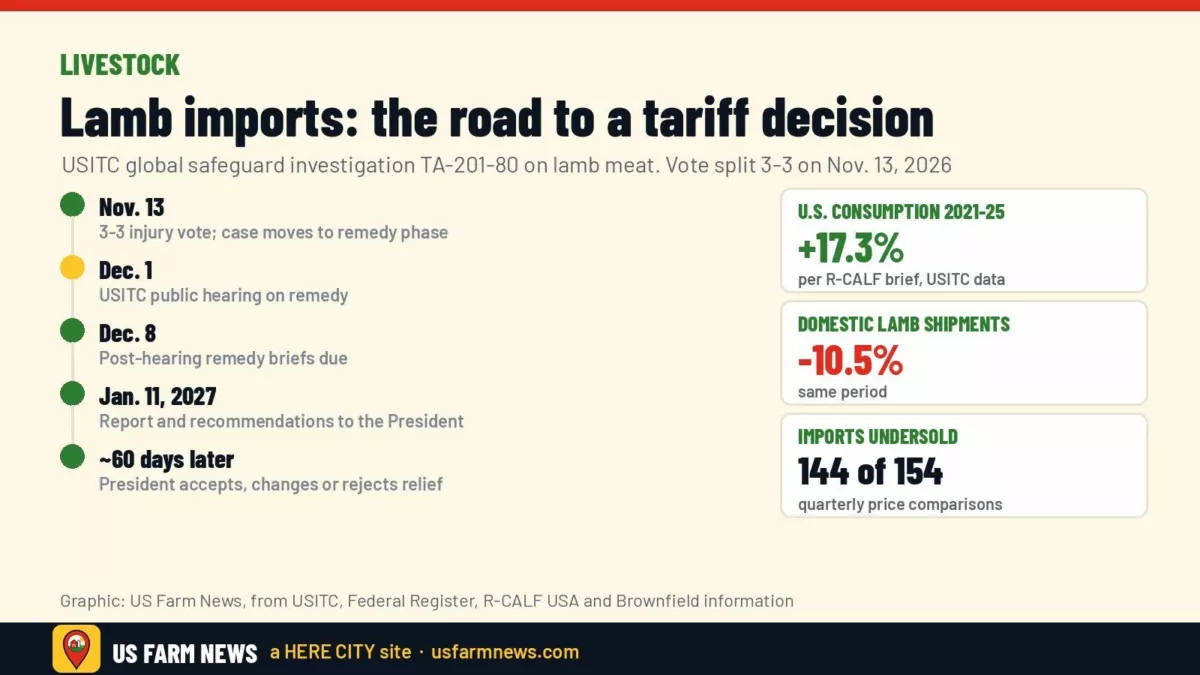
The case for injury rests on a few figures. R-CALF says commission data in its post-hearing brief showed:
- U.S. lamb consumption rose 17.3% from 2021 through 2025.
- Shipments of domestic lamb fell 10.5% over the same years.
- Imports undersold U.S. lamb in 144 of 154 quarterly price comparisons.
“The import price is the ceiling, and everything I can pay a rancher sits underneath it,” Montana packer Charlie Hollenbeck of Cowboy Meat Company testified, according to R-CALF.
The other side
Australia’s ambassador to the U.S., Greg Moriarty, told the commission that limiting imports would raise costs for U.S. consumers, shrink supply and could undo growth in U.S. lamb demand, ABC News reported. Australia shipped more than 100,000 tonnes of lamb to the U.S. last year, according to ABC. That lamb already pays a 12.5% tariff, ABC said. Australian groups argue their product fills demand that U.S. producers can’t supply.
Australia, New Zealand and the United Kingdom opposed relief in the case, while Chile and Spain asked for their products to be excluded, R-CALF said.
Timeline
- Nov. 30: Prehearing conference for the remedy phase, per the commission’s Federal Register notice.
- Dec. 1: Public remedy hearing in Washington.
- Dec. 8: Post-hearing briefs on remedy due.
- Jan. 11, 2027: USITC report, with both groups’ findings and remedy recommendations, due to the President.
- About 60 days after that: The President can accept the recommendations or choose a different remedy, ASI said, according to Brownfield.
The vote itself imposes no tariffs or quotas, R-CALF noted.
What it means for your operation
Any relief would be temporary. A Section 201 safeguard is meant to give an industry time to adjust to import competition, and it doesn’t require proof of dumping or subsidies, R-CALF explained. Producers weighing ewe retention or feeder purchases for 2027 shouldn’t count on a tariff until the President acts, likely in the first quarter of the year. R-CALF CEO Bill Bullard has called the sheep industry a “canary in the coal mine” for cattle, so cattle groups will watch the outcome closely as well.
For more livestock market news, see our report on record-low cattle placements and our coverage of the latest U.S. tariff proposals.
Frequently asked questions
Did the ITC vote put a tariff on lamb?
No. The 3-3 vote moved the case to a remedy phase. Any tariff or quota would come only if the President decides to act after the commission reports by Jan. 11, 2027.
What is a Section 201 case?
It’s a safeguard case under the 1974 trade law that looks at imports from every country. It asks whether an import surge is seriously hurting a U.S. industry and can lead to temporary relief. It doesn’t require proof of unfair trade.
Which country is most affected?
The commissioners who voted yes named Australia, finding its lamb alone to be a major cause of the harm or threatened harm.
Get the Daily Ag Business Briefing
Markets, policy and farm business in one free email each weekday.