A HERE CITY site

USTR Proposes Tariffs of Up to 20% on China and 13 Other Economies, Plus a Sugar Duty Aimed at Brazil
USTR proposed Section 301 tariffs of 15% to 35% on 14 economies, up to 20% on China, and a new over-quota sugar duty. What it means for farm exports, costs.
Key takeaways
- The U.S. Trade Representative on Nov. 25 proposed new Section 301 tariffs on 14 economies, including up to 20% on many Chinese goods 15% on the European Union and up to 15% on Japan and South Korea.
- USTR separately proposed an added tariff on out-of-quota sugar from Brazil, applied to all countries so other exporters can’t backfill, plus a 10% duty on Brazilian aircraft.
- Farm groups worry about retaliation against U.S. soybeans and higher costs for imported machinery parts, Farm Policy News reported.
- Comments on the 14-economy plan are due Jan. 5, 2027, with hearings starting Jan. 25; sugar comments close Dec. 30.
The Trump administration opened a new front in its trade policy the day before Thanksgiving, proposing tariffs on 14 trading partners that buy a large share of U.S. farm exports. The Office of the U.S. Trade Representative said it had found that China, the European Union, Japan, India and 10 other economies follow industrial policies that build “structural excess capacity” in manufacturing and burden U.S. commerce. The proposed duties would not take effect until after public comment and hearings early next year.
For farmers, the bigger risk may be the response rather than the tariffs themselves. Many of the targeted economies buy U.S. crops and meat, and the chance of retaliation against American agriculture is a leading concern, according to Farm Policy News.
What USTR proposed
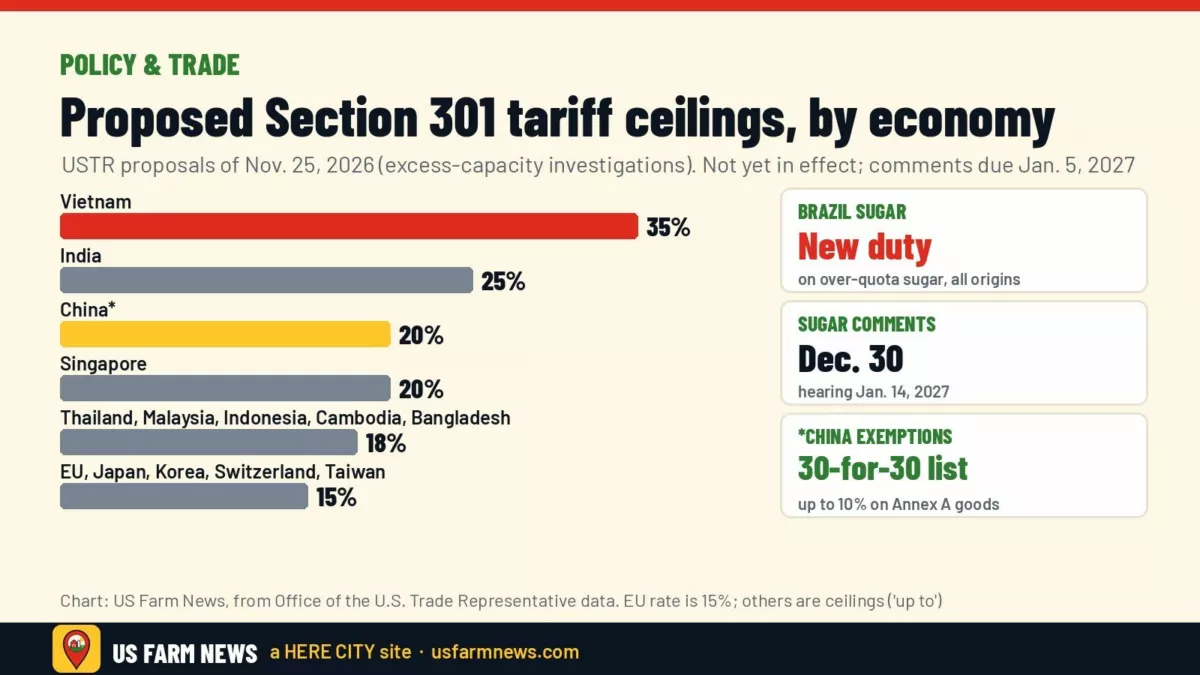
Trade Representative Jamieson Greer made determinations in 14 of the 16 investigations USTR opened on March 11, 2026, the agency said. It made no finding yet on Mexico or Norway. The proposed ceilings, generally on all goods with exemptions listed in each Federal Register notice, are:
- China: up to 20% on most goods and up to 10% on goods in a separate annex. Products on the “30-for-30” import list agreed under the U.S.-China Board of Trade would be exempt.
- Vietnam: up to 35%.
- India: up to 25%.
- Singapore: up to 20%.
- Bangladesh, Cambodia, Indonesia, Malaysia and Thailand: up to 18%.
- European Union: 15%. Japan, South Korea, Switzerland and Taiwan: up to 15%. These rates are figured net of most-favored-nation duties.
USTR said the China rate reflects the 20% tariff level and commitments announced in the Kuala Lumpur arrangement that President Trump and President Xi Jinping reached on Oct. 30, 2025. A senior White House official told reporters the China rate would have been 40% without the 30-for-30 framework, and that the new levies won’t be stacked on the separate Section 301 forced-labor tariffs; a country will pay whichever is higher, Agri-Pulse reported.
The agency said it received 1,070 comments and heard from nearly 140 witnesses before reaching its findings.
A new sugar tariff aimed at Brazil
In a second action the same day, Greer proposed changes to the Section 301 tariffs already imposed on Brazil. Brazil keeps shipping large volumes of over-quota sugar, along with finished aircraft, to the U.S., and both have been exempt from the current action, he said. The plan would add a specific duty on raw and refined sugar entering above the quota and a 10% tariff on Brazilian aircraft.
Because sugar is a fungible global commodity and Brazil leads the world in production and exports, USTR wants the sugar duty applied to every country. Otherwise, it said, Brazilian sugar could fill other countries’ markets while their sugar moves to the U.S. Requests to appear at the hearing are due Dec. 7, written comments by Dec. 30, and the hearing is set for Jan. 14, 2027. A higher duty on over-quota sugar would add a layer of protection for domestic beet and cane growers.
Why farm country is uneasy
Farm Policy News at the University of Illinois pulled together reporting showing that the announcement raised concerns about retaliation, higher input costs and more volatile markets while producers draw up 2027 budgets. The worry in the soybean market is that Beijing could answer by shifting more purchases to Brazil and Argentina. Higher duties on imported industrial components could also raise machinery and repair costs, depending on the final tariff lists.
The timing is delicate. China bought 132,000 tons of 2026-27 U.S. soybeans on Wednesday, its first announced purchase since Presidents Trump and Xi met at APEC earlier this month, Brownfield reported. President Trump said this week that Beijing would buy far more U.S. farm goods than first planned, Agri-Pulse reported. USTR also said its new agricultural working group with China’s Ministry of Commerce met for the first time this week in Beijing to discuss non-tariff barriers and market access. We covered the earlier extension of the China tariff pause and the soybean duty and the Thailand deal’s $2.6 billion farm purchase promise, both of which could be tested by the new proposals.
What it means for your operation
- Soybean and grain marketing: watch for any response from Beijing before the Jan. 5 comment deadline. A retaliatory move would most likely show up first in soybean basis and new-crop export sales.
- Equipment and parts: if you plan to buy machinery or stock up on parts for 2027, ask your dealer whether quoted prices could change once final tariff lists come out.
- Sugar growers: the Brazil sugar proposal is open for comment through Dec. 30. Commodity groups usually file on members’ behalf.
- Specialty exporters: exporters of tree nuts, fruit, dairy and meat to the EU, Japan, Korea, India and Southeast Asia should follow those governments’ reactions.
What to watch
- Dec. 7: requests to appear at the Brazil sugar and aircraft hearing.
- Dec. 30: written comments due on the Brazil proposal.
- Jan. 5, 2027: comments and hearing requests due on the 14-economy proposals.
- Jan. 14 and Jan. 25, 2027: USTR hearings on Brazil and the excess-capacity actions.
Frequently asked questions
Are the new tariffs in effect now?
No. USTR proposed them on Nov. 25, 2026, and will take public comments through Jan. 5, 2027, and hold hearings starting Jan. 25 before any final action.
Are farm goods from China exempt?
Products on the U.S.-China “30-for-30” import list are exempt under USTR’s proposal. Other Chinese goods would face up to 20% or, for an annex of products, up to 10%.
Why would a sugar tariff apply to every country?
USTR said sugar is a fungible global commodity, so a duty on Brazil alone could let Brazilian sugar replace other countries’ supplies while those countries ship more to the U.S.
Get the Daily Ag Business Briefing
Markets, policy and farm business in one free email each weekday.