A HERE CITY site

Deere Sees Large-Ag Equipment Sales Rising 5% to 15% in 2027 as Early Orders Jump and Dealer Lots Thin: What Buyers Should Know
Deere expects U.S.-Canada large ag sales up 5% to 15% in 2027, with early orders up double digits and lean dealer lots. Five things to weigh before buying.
Key takeaways
- Deere expects U.S. and Canadian large ag equipment industry sales to rise 5% to 15% in fiscal 2027 after a 15% drop in fourth-quarter sales of its big-farm machinery.
- Early orders are up by double digits from a year ago; planters led, and combine orders already match last year’s full program, Deere said on its Nov. 25 earnings call.
- New large-ag inventory on dealer lots is down 10% from last year’s low levels, and used combine inventories are about 30% below their peak.
- Deere is planning on roughly 3% price realization in its large-ag segment, so buyers should expect list prices to keep creeping up.
The biggest name in farm machinery says the equipment downturn has bottomed out, at least in North America. Deere & Company told investors on Wednesday that it expects industry sales of large tractors, combines, sprayers and planters in the U.S. and Canada to climb 5% to 15% in its 2027 fiscal year, which began Nov. 2. That forecast came as the company reported a 15% drop in fourth-quarter sales in its Production & Precision Agriculture segment, the business that builds big-farm machines.
For farmers deciding whether to trade, buy or wait, the numbers behind that outlook say more than the headline. New and used inventories are lean, early orders are strong, and Deere is planning on higher prices.
This article summarizes published company information and is not a hands-on review or purchase recommendation.
The fourth-quarter numbers
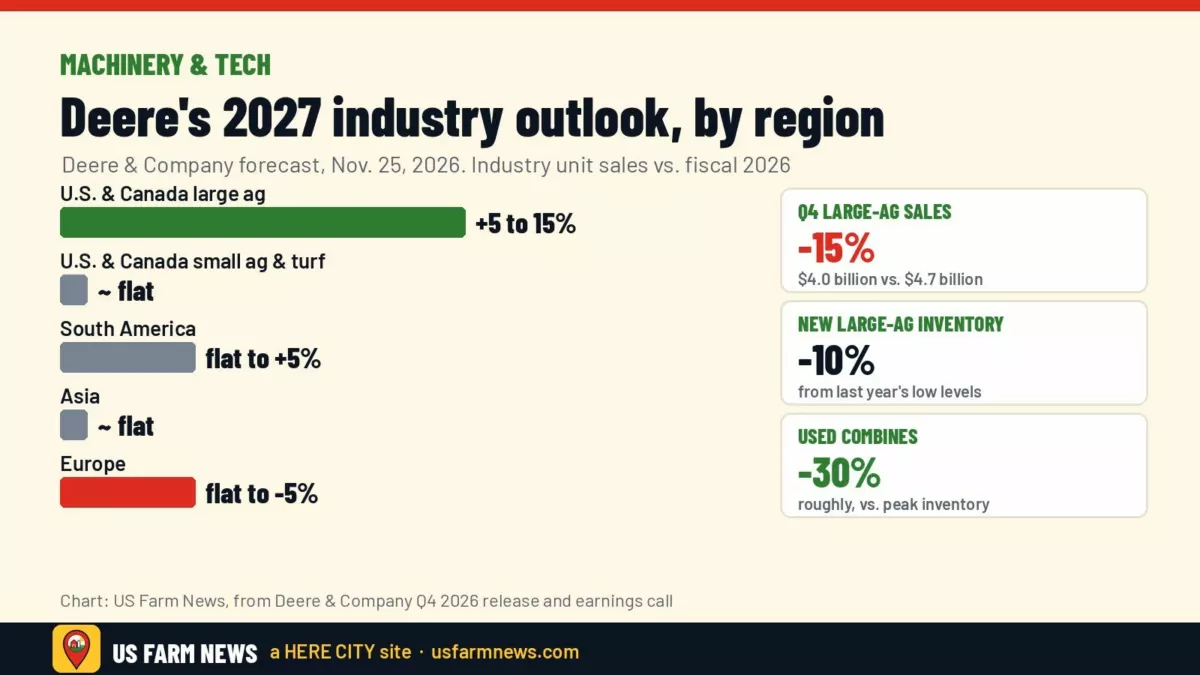
- Production & Precision Ag net sales: $4.018 billion in the quarter ended Nov. 1, down 15% from $4.740 billion, mostly because Deere shipped fewer machines.
- Segment operating profit: $406 million, down 33%, for a 10.1% margin, compared with 12.7% a year earlier.
- Small Ag & Turf: sales up 10% to about $2.7 billion; operating profit rose to $233 million, helped by dairy and livestock customers, Manufacturing Dive reported.
- Full year: net sales and revenues rose 4% to $47.704 billion, while net income slipped to $4.860 billion from $5.027 billion.
“Even at cyclical lows, we executed with discipline,” Chairman and CEO John May said in the company’s release.
Why Deere expects a rebound
On the call, Dan Pulley, Deere’s manager of investor communications, said the crop price rally in August and September let many growers sell part of their crop at better margins. He also cited shrinking used inventories and replacement demand from an aging fleet. In North America, orders booked through the early order programs are ahead of last year by double-digit percentages. Spring-use products closed their programs up double digits, with planters especially strong, investor relations director Chris Seibert added. Combine orders, though that program is still open, already match last year’s entire program, he said.
Deere also flagged what could slow the recovery. With crop prices off their highs and input costs still elevated, thin farm margins will probably slow how fast the recovery comes, Pulley said. Outside North America, Chief Financial Officer Brent Norwood said conditions in Europe and Brazil remain difficult.
What lean inventories mean for buyers
New large-ag machine inventory is down 10% from what Seibert called “already low levels” last year. Dealers have only a handful of big combines and high-horsepower tractors in stock, he said. On the used side, North American inventories of high-horsepower tractors and combines are each down by double digits from a year ago. Compared with their peaks, used high-horsepower tractor stocks are off 25% and used combine stocks are off about 30%.
Dealers outside the Deere network are cutting aged inventory too. CNH dealer group Titan Machinery said its used equipment inventory fell $59 million between Jan. 31 and Oct. 31, while new inventory rose $20 million, according to Farm Equipment.
Deere’s 2027 plan for the large-ag segment also includes about 3 points of price realization, partly offset by currency. Its industry outlook, by region:
- U.S. and Canada, large ag: up 5% to 15%
- U.S. and Canada, small ag and turf: about flat
- South America (tractors and combines): flat to up 5%
- Europe: flat to down 5%
- Asia: about flat
Five things to weigh before you order
- Get in early on high-demand machines. With few large combines and big tractors on lots and combine orders already running ahead, waiting for spring could mean longer lead times or fewer configuration choices. Ask your dealer when the current early order window closes.
- Budget for higher list prices. A planned 3% price realization means a lower quote is unlikely next year. Compare early-order discounts and financing offers against what a later purchase would cost.
- Your trade-in may be worth more than you think. Tighter used supplies usually support values for clean, late-model equipment. Get more than one appraisal, and see our earlier look at leasing versus buying under high interest rates.
- Watch tariffs and labor. Deere expects roughly $300 million more tariff expense in 2027, mainly because 2026 refunds won’t repeat, Seibert and Norwood said. Norwood also said its UAW labor agreements expire at the end of fiscal 2027 and that it is building enough inventory to cover fiscal 2028 sales, with plans to keep plants running through a stoppage if needed. Earlier this month Deere announced it will close its Ottumwa and Clarion, Iowa, plants.
- Price precision options on their own merits. About a third of orders in Deere’s sprayer early order program included See & Spray, Seibert said. The technology now covers about 12 million acres, including fields in Australia and South America. Run the numbers on herbicide savings for your weed pressure; our smart sprayer break-even guide walks through the math.
What to watch
Deere said the top of its sales range depends on filling the rest of its North American order book at a pace similar to the early order programs. Its next quarterly report will show whether tractor orders hold up. Farmers who placed early orders should confirm delivery dates in writing.
Get the Daily Ag Business Briefing
Markets, policy and farm business in one free email each weekday.