A HERE CITY site

Korea’s AI-Nutie Uses Greenhouse Cameras to Feed Hydroponic Tomatoes, Cutting Daily Nutrient Work Up to 80%: What Growers Can Learn
Korea's AI-Nutie reads greenhouse CCTV to set tomato nutrient doses, matching a skilled grower 98.5% of the time. Six questions before buying AI fertigation.
Key takeaways
- South Korea’s Rural Development Administration (RDA) unveiled AI-Nutie on Nov. 24, a system that reads greenhouse camera video and sets hydroponic tomato nutrient doses on its own.
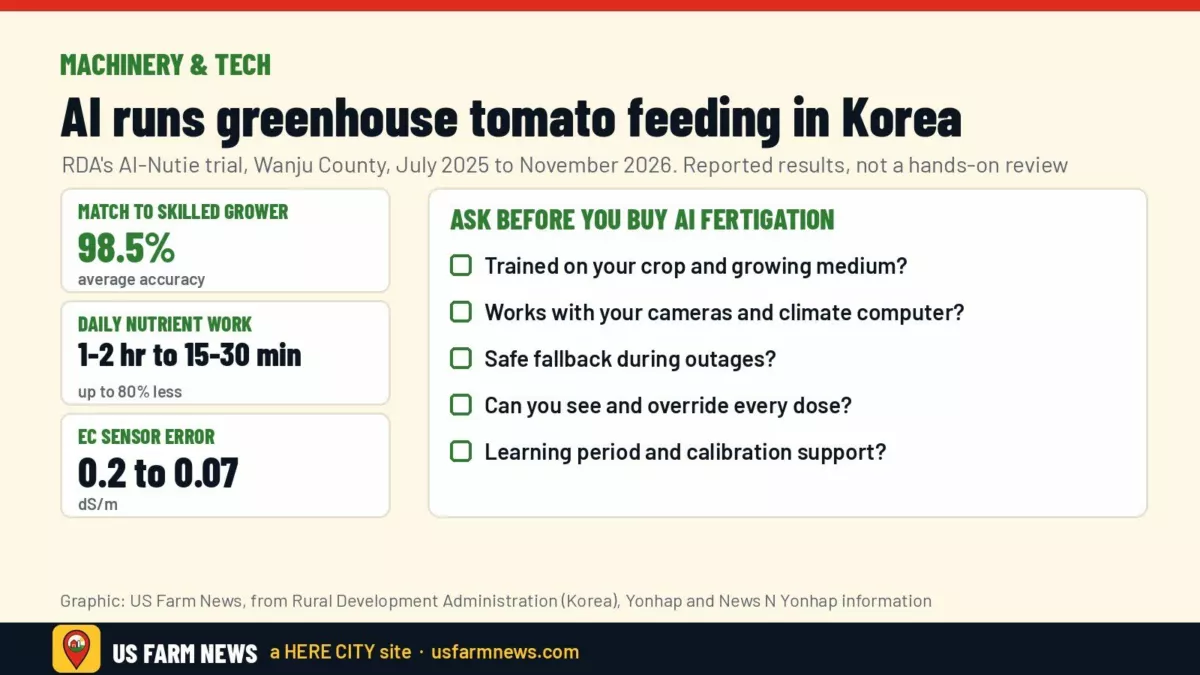
- In a trial on a tomato farm in Wanju County that began in July 2025, it matched a skilled grower’s feeding and drainage pattern with 98.5% average accuracy.
- Daily nutrient management fell from 1-2 hours to 15-30 minutes, a cut of up to 80%, the agency said.
- Korea plans to install it at 15 small hydroponic tomato and strawberry operations starting in 2027. It isn’t sold in the U.S., but its design offers a checklist for American greenhouse growers.
Mixing and dosing nutrient solution is one of the most skill-heavy chores in hydroponic vegetable production, and one of the hardest to hand to a new employee. South Korea’s national farm research agency says it has taught an AI system to do it nearly as well as an experienced grower, using the security cameras most greenhouses already have.
The Rural Development Administration announced the system, called AI-Nutie, on Nov. 24. The tool isn’t available in the United States, and the results come from a single farm trial. Still, how it works, and the caveats Korean researchers attached to it, are a useful guide for U.S. tomato, cucumber and strawberry growers being pitched AI fertigation controllers.
How AI-Nutie works
The system links two parts that are usually separate: crop sensing and nutrient control.
- Seeing the crop. An object-detection model known as YOLO picks out tomato leaves, stems, growing points and flower clusters in footage from existing greenhouse CCTV cameras and tracks growth in real time. It runs on edge hardware at the farm, so video analysis keeps going without an internet connection, Yonhap News Agency reported.
- Deciding the dose. A second model, a time-series network called LSTM, combines the crop data with air temperature and humidity, evapotranspiration, the weight of the growing medium, and how much solution goes in and drains out. It then sets the nutrient concentration, electrical conductivity (EC), pH and feeding times, and the dosing unit delivers the solution, according to RDA.
- Better sensing. RDA developed its own EC sensor, cutting measurement error from 0.2 dS/m to 0.07 dS/m. The system follows two Korean smart-greenhouse standards so it can talk to other companies’ climate controllers.
- A human override. Growers watch the system on a phone or computer and can change the values if they disagree, News N Yonhap reported.
What the trial showed
RDA tested AI-Nutie on a tomato farm in Wanju County, North Jeolla Province, from July 2025 through this month. It reproduced the skilled grower’s feeding and drainage management with 98.5% average accuracy, the agency said. Looked at one by one, accuracy for EC, substrate weight and pH ranged from 89% to 99%, News N Yonhap reported.
Daily tasks such as checking EC and pH, mixing solution and logging drainage dropped from 1 to 2 hours to 15 to 30 minutes. RDA also expects less overuse of water and fertilizer. The agency told News N Yonhap that tighter nutrient control could raise yields 10% to 20%, but said results by crop and farm still need to be confirmed. Patent applications have been filed.
Starting next year, RDA plans to install the system at 15 small and mid-sized hydroponic tomato and strawberry operations, about half a hectare each. The project budget is 70 million won per site, with the national government paying half, Money Today reported.
The caveats researchers flagged
Korean reporting was candid about the limits, and they apply to any AI greenhouse controller:
- It needs time to learn your farm. The AI takes at least two weeks to pick up a farm’s practices, so don’t expect perfect values on day one, News N Yonhap reported.
- Old cameras may not cut it. Blurry images or poor angles can make older cameras unsuitable for tracking growth. The model was trained on 4K video, and tests on lower-resolution HD feeds that farms commonly use are still under way.
- Integration isn’t automatic. Equipment with different signal formats or sensor layouts may need extra parts or rework.
- Maintenance matters. Errors build up if lenses aren’t cleaned and sensors aren’t recalibrated, and ongoing costs include calibration, consumables and software updates.
- It’s tomato-only for now. Moving to strawberries or other crops needs more video and growing records for each crop.
Questions to ask before buying an AI fertigation system
- Was the model trained and tested on my crop, my growing medium and a greenhouse like mine?
- Does it work with my existing cameras, sensors and climate computer, or will I be buying new hardware?
- What happens during an internet or power outage? Does it fall back to a safe recipe?
- Can I see and override every dose it sets, and does it keep a record?
- How long is the learning period, and who supports calibration during that time?
- What are the yearly costs for sensor calibration, replacement parts and software?
Precision feeding is part of a broader push into camera-based crop AI. We recently covered Deere’s purchase of Orchard AI and its tree-by-tree cameras and AI camera systems for dairy barns.
Get the Daily Ag Business Briefing
Markets, policy and farm business in one free email each weekday.