A HERE CITY site

U.S. Potato Growers Push to End Canada’s Decades-Old B.C. Dumping Duties as Tribunal Ruling Nears Feb. 4
Canada's dumping floor on U.S. fresh potatoes sold into British Columbia runs about C$40 to C$45 per cwt. Growers want a USMCA fix; a ruling is due Feb. 4.
Key takeaways
- Canada has charged anti-dumping duties on some U.S. fresh potatoes shipped into British Columbia since 1984, and the National Potato Council wants the issue settled in the USMCA review.
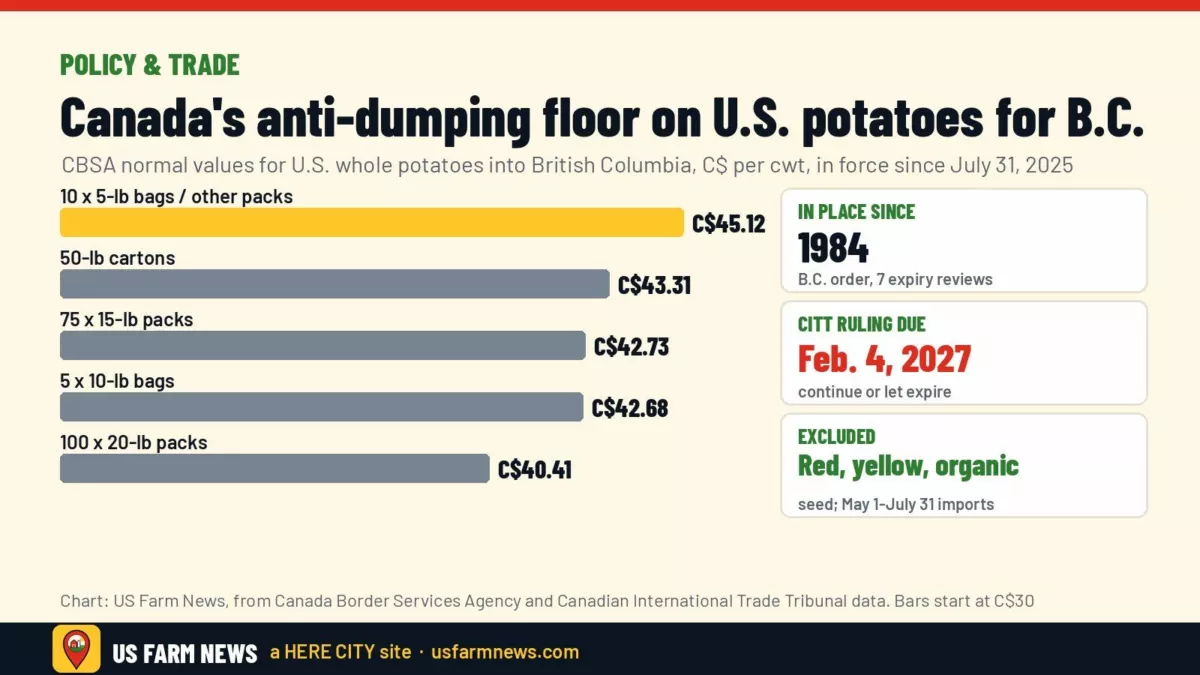
- Canada’s border agency raised its benchmark “normal values” in mid-2025, and duty collections then rose sharply. Benchmarks now run C$40.41 to C$45.12 per cwt, depending on the pack.
- The Canada Border Services Agency found in August that dumping would likely continue if the order ends. The Canadian International Trade Tribunal must rule on injury by Feb. 4, 2027.
- Red, yellow, organic and seed potatoes are excluded, and so is anything shipped May 1 to July 31.
U.S. potato growers want Washington to use the review of the U.S.-Mexico-Canada Agreement to end a decades-old Canadian duty on fresh potatoes headed to British Columbia. Kam Quarles, who leads the National Potato Council, told Brownfield the duties are costing U.S. growers millions of dollars in fresh potato sales they could otherwise make in Canada.
The timing matters. A Canadian trade tribunal is now deciding whether to keep the order alive, and its ruling is due in early February.
Why it matters to growers in the Northwest
British Columbia sits right next to the biggest U.S. fresh potato states. Canada’s border agency noted in its review that most U.S. potatoes are grown in western states such as Washington, Oregon and Idaho, just south of the B.C. line, with long-standing sales channels into the province. Almost all of B.C.’s own crop goes to the fresh table market rather than processing, the agency said, so local growers depend on that market and want protection from lower-priced U.S. product.
For a U.S. shipper, the order works like a price floor. Shipments priced under the benchmark set by the Canada Border Services Agency (CBSA) owe anti-dumping duty. Shippers who price at or above it do not, and CBSA says most exporters have raised their prices to stay over the line.
What changed in 2025
Quarles told Brownfield that a review last year tripled the price thresholds, pushing them above the highest prices U.S. growers had ever been paid under the policy. “We are Canada’s largest customer for potatoes,” he said, and noted that the U.S. has no anti-dumping orders against Canadian products.
CBSA records back up the jump in collections. The agency updated the benchmarks on July 31, 2025, and they applied to imports from Aug. 1 through Dec. 31, 2025. During that window, duties assessed and collected rose significantly, CBSA wrote. It said the earlier values, set in 2015, may not have matched market conditions.
The benchmarks now in force for shippers without their own CBSA-issued values, per hundredweight in Canadian dollars:
- 10 x 5-lb bags: C$45.12
- 5 x 10-lb bags: C$42.68
- 75 x 15-lb packs: C$42.73
- 100 x 20-lb packs: C$40.41
- 50-lb cartons: C$43.31
- All other packaging: C$45.12
One shipper, Allied Potato Northwest of Pasco, Wash., has had its own CBSA-set values since January 2026, after an administrative review based on its U.S. selling prices, according to CBSA.
Over the review period, from August 2022 through 2025, CBSA assessed $752,114 in Canadian anti-dumping duties on U.S. potatoes. The agency said falling duty totals across much of that period showed exporters were mostly raising prices to stay above the floor.
What is and isn’t covered
The order covers whole U.S. potatoes for use or consumption in B.C. only. CBSA lists these exclusions:
- seed potatoes
- anything imported from May 1 through July 31
- red, yellow and exotic varieties
- white and russet potatoes in 50-lb cartons in count sizes 40, 50, 60, 70 and 80
- certified organic potatoes
Canada’s side
Canadian officials say a surplus of U.S. potatoes keeps pressing B.C. prices down, sometimes below what local growers spend to produce them, Brownfield reported. In its Aug. 28 finding, CBSA pointed to falling overall demand for potatoes, persistent U.S. oversupply, the close link between U.S. supplies and prices, and the short haul from U.S. growing areas. It concluded that dumping would likely continue or resume if the order expired.
The case goes back four decades. CBSA’s history shows a first injury finding in June 1984, a second case covering other potatoes in 1985 and 1986, and seven expiry reviews since, each of which kept the measures in place.
The tribunal decision
The Canadian International Trade Tribunal (CITT) opened its expiry review, No. RR-2026-001, on April 1. Since CBSA found dumping likely to continue, the tribunal now has to decide by Feb. 4, 2027, whether that dumping would likely injure B.C. growers. If it finds injury is likely, the order continues, with or without changes. If not, the order expires, and CBSA says duties paid on potatoes released after the scheduled expiry date would be refunded to importers.
The USMCA angle
Potatoes are one of several farm irritants in the agreement’s review. Virginia Houston, managing director of government affairs at the American Farm Bureau Federation, told Brownfield the incoming Congress could have a hand in how the review plays out. With Canada, the Farm Bureau wants fair administration of the dairy tariff-rate quotas Canada agreed to, rather than a larger quota, she said. With Mexico, she flagged fresh produce imports that arrive during U.S. harvest and pull down prices for berry and vegetable growers. USMCA stays in force while the review continues, Brownfield noted.
What to watch
- Feb. 4, 2027: CITT ruling on whether the B.C. order continues.
- USMCA talks: whether U.S. negotiators raise the potato duties, as the potato council asks.
- Pricing now: shippers selling russets or whites into B.C. should check each load against the CBSA benchmark for that pack, or ask their importer, before quoting.
U.S. growers have pushed for wider fresh potato access in other markets as well. See our earlier story on fresh potato access to Japan, and our look at the new U.S. tariff proposals and farm trade.
Frequently asked questions
Do the duties apply to all U.S. potatoes sold in Canada?
No. They apply only to certain whole fresh potatoes for use or consumption in British Columbia. Seed, red, yellow, exotic and organic potatoes are excluded, and so are shipments from May 1 through July 31.
When will Canada decide whether to keep the order?
The Canadian International Trade Tribunal must rule by Feb. 4, 2027.
How can a U.S. shipper avoid the duty?
By selling at or above the CBSA normal value for that package type. A shipper can also take part in a CBSA review to get its own values, as one Washington exporter has.
Get the Daily Ag Business Briefing
Markets, policy and farm business in one free email each weekday.